The formula is published — almost nobody has read it
The main thing worth knowing about Uzum search: the marketplace documented its own ranking rules. They do not have to be guessed from observation or bought from a consultant.
The weights:
- at the second ranking stage, product rating weighs 81%, the title 18%;
- at the third stage, conversions and purchases weigh 51%, text relevance 37%.
Nearly all practical work on a product card follows from those four numbers.
Where the description stands
The list of text fields the formula uses for relevance does not include the description: it has the title, filters, synonyms, the category name and the category path.
Update, 27 September 2026. This section used to say the description plays no part in ranking at all. That was too strong. Uzum’s search team wrote in a Habr article in May 2024 that its vector search model takes the product title, description and attributes, and that the text-similarity feature built on it turned out to be the most important feature in the ranking model. Uzum’s seller manual (section 12.3, search results) also advises including popular search phrases related to the product in the description.
So the conclusion is: the description is not the main lever. Rating, title and attributes weigh more and pay off faster. A long keyword-stuffed text will not rescue a position. A description written for the buyer, with the main search phrases occurring naturally, does no harm, and by Uzum’s own account search takes it into account.
Rating weighs the most — and it is not about text
81% at the second stage is rating. No amount of card work substitutes for it.
Hence an unwelcome but honest conclusion: if a product has a low rating, optimising the card will not help. First fix what caused the rating — quality, packaging, delivery times, replies to reviews — and only then work on the text.
The reverse holds too: a high-rated product with a mediocre card outranks a beautifully built card on a product with bad reviews.
The title is the card’s main text
18% at the second stage is the title. The main job of the text fits on one line.
The rules for it are boring and effective: what the product is, the brand, the key characteristic that separates it from the item next to it. No repetition, no “bestseller”, no strings of synonyms.
The title is also what the buyer reads in the results. It affects the click, the click affects conversion, and conversion weighs 51% at the third stage. One line does two jobs.
Filter attributes: boring, which is why nobody does them
Filling in product attributes for filters brings +11% add-to-cart and +15% search traffic.
The mechanism is transparent: a buyer who has ticked three filter boxes is a buyer with intent already formed. If your product has the relevant attribute empty, it does not enter that list. Not “ranks lower” — does not appear.
This is the dullest work in e-commerce: dozens of fields, each filled in by hand. Which is exactly why almost nobody does it, and exactly why it still confers an advantage.
Why it cannot be uploaded in bulk
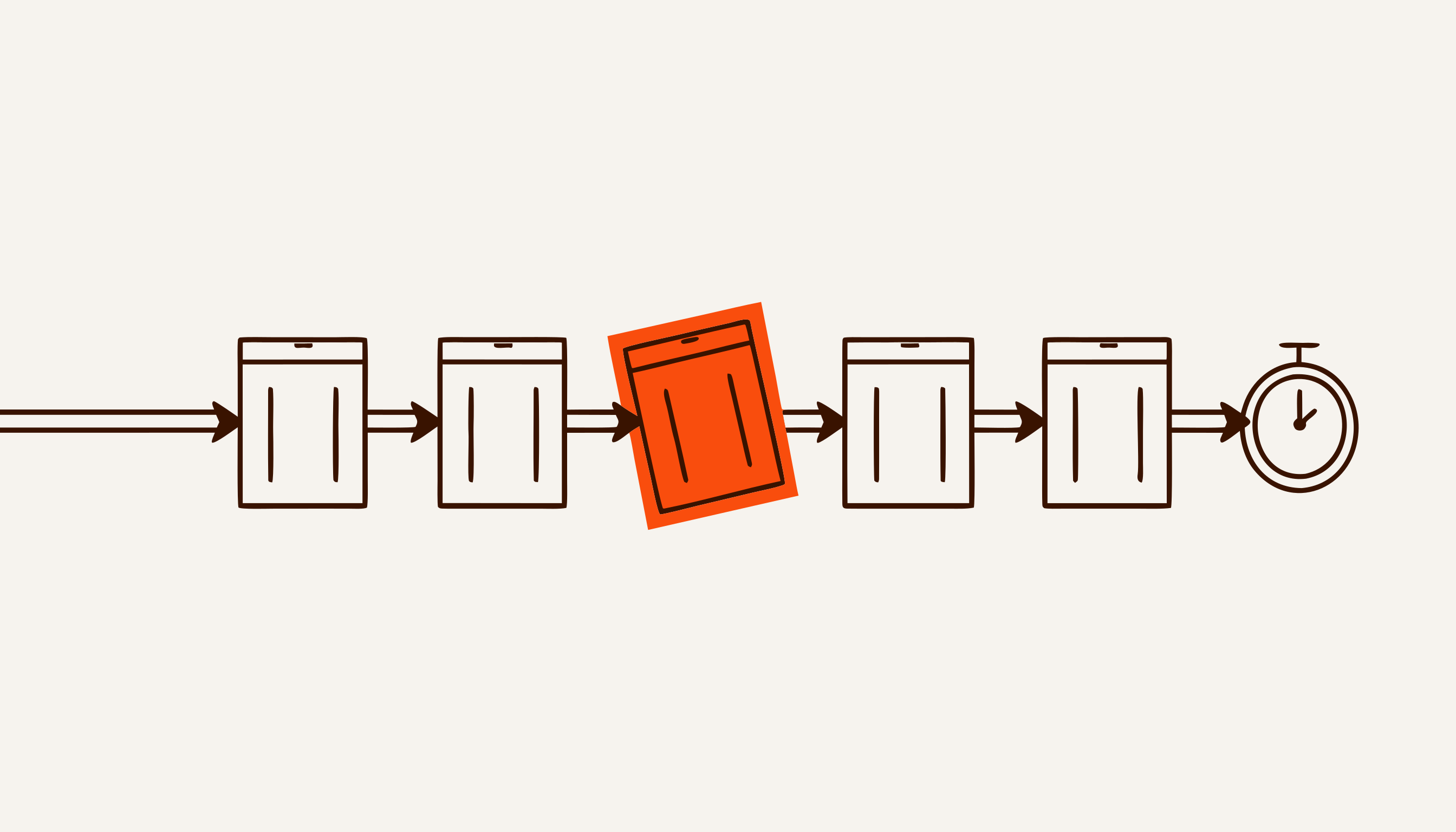
Uzum has no content API. The Product API exposes four endpoints, and uploading product cards is not among them. There is no bulk upload either.
Every card is created by hand in three steps. For a seller with thirty products that is an evening. For a seller with three thousand it is the bottleneck that leaves half the catalogue sitting with empty attributes for years.
That gap — between what the marketplace rewards and how much manual work it demands — is the real problem for an Uzum seller. It is not about creativity, it is about the volume of identical actions.
The red line on images
Uzum prohibits images that mislead about a product’s properties. The rule is strict, and it cannot be broken even by accident.
The working boundary: the product in frame always comes from the seller’s original photo. A neural network touches the surroundings only — background, light, scene. The moment the product itself is generated — its colour, its contents, its size — the card is a violation of marketplace rules, not clever optimisation.
What to do this week
- Look at products rating below your average — a better card will not save them, they need the cause fixed.
- Rewrite titles to “product + brand + key characteristic”.
- Open your ten highest-margin products and fill in every filter attribute to the end.
- Do the description last. Rewrite it for the buyer and mention the main search phrases naturally, without keyword stuffing.
Everything above is copied out of the marketplace breakdown we did for our own product. That product is still being built; the breakdown holds regardless.