Automating a whole business in one project is a bad plan: deadlines drift, and there is nothing to measure the result against. What works is one process at a time, with a metric written down first. That is how we approach business process automation in Tashkent, Samarkand and across Uzbekistan — on top of the CRM, 1C, spreadsheets and messengers you already use. The step-by-step plan is in How to automate your business.
What business automation is, in plain terms
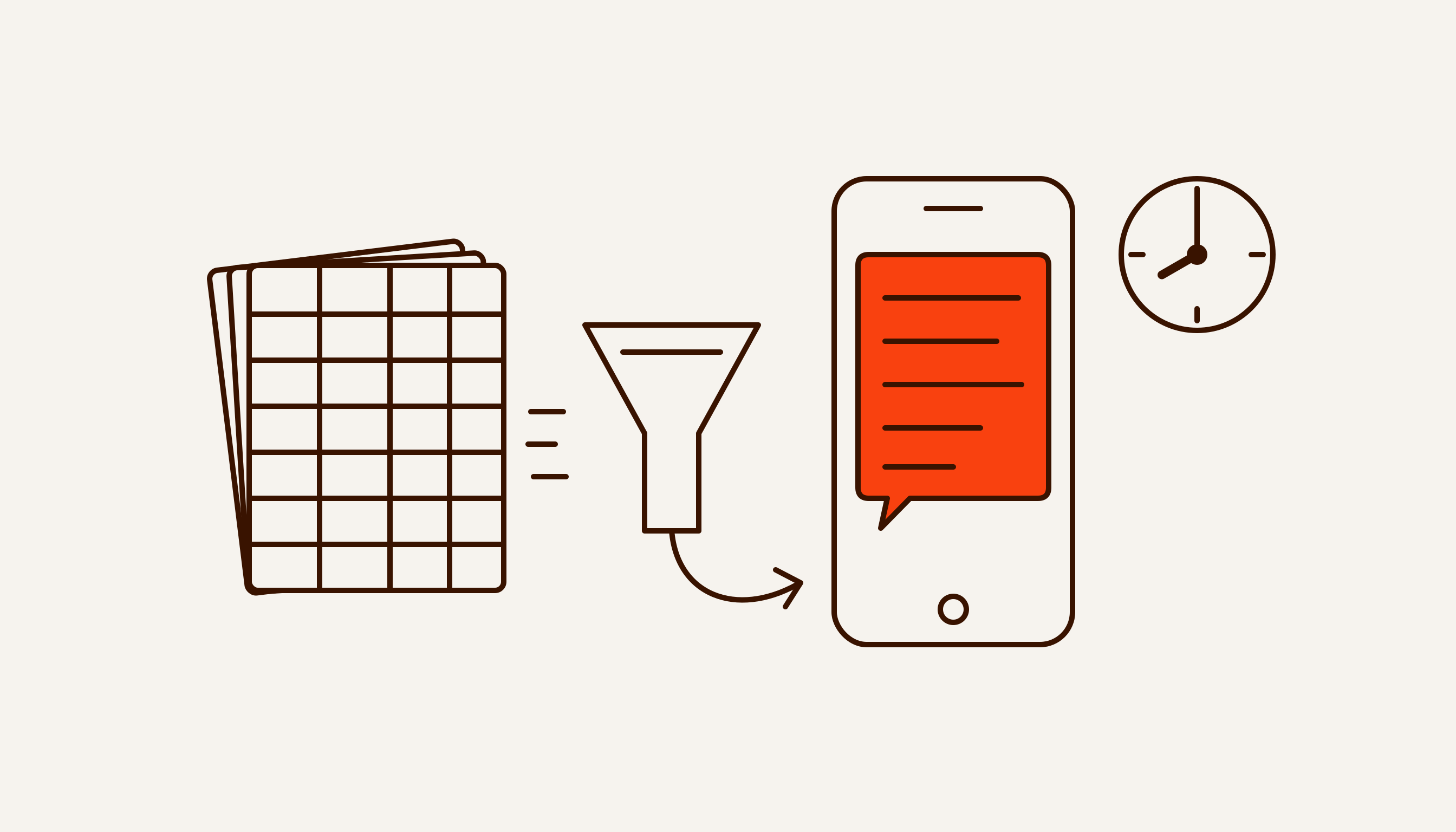
Business automation means handing repetitive work from people to software: whatever an employee does by the same rule dozens of times a week, the system does on its own. A Telegram enquiry becomes a CRM deal, a 1C invoice goes out to the client, a summary lands in the manager’s chat by 9:00. Two tools do this, usually together.
Rule-based automation
A rule is an “if — then”: if an enquiry comes from the website, create a deal and notify a manager; if an invoice is three days overdue, remind the client. Rules need data already laid out in fields — a form, a spreadsheet row, a CRM status. They are cheap, fast and predictable, and helpless when the input does not fit.
AI automation
An AI model handles what is not in fields: free text, voice notes, emails, scanned delivery notes. It tells a price question from a complaint, pulls bank details out of a PDF, drafts a reply in Uzbek. It can also be wrong, so checks go around it, and decisions that change a client’s position stay with a person.
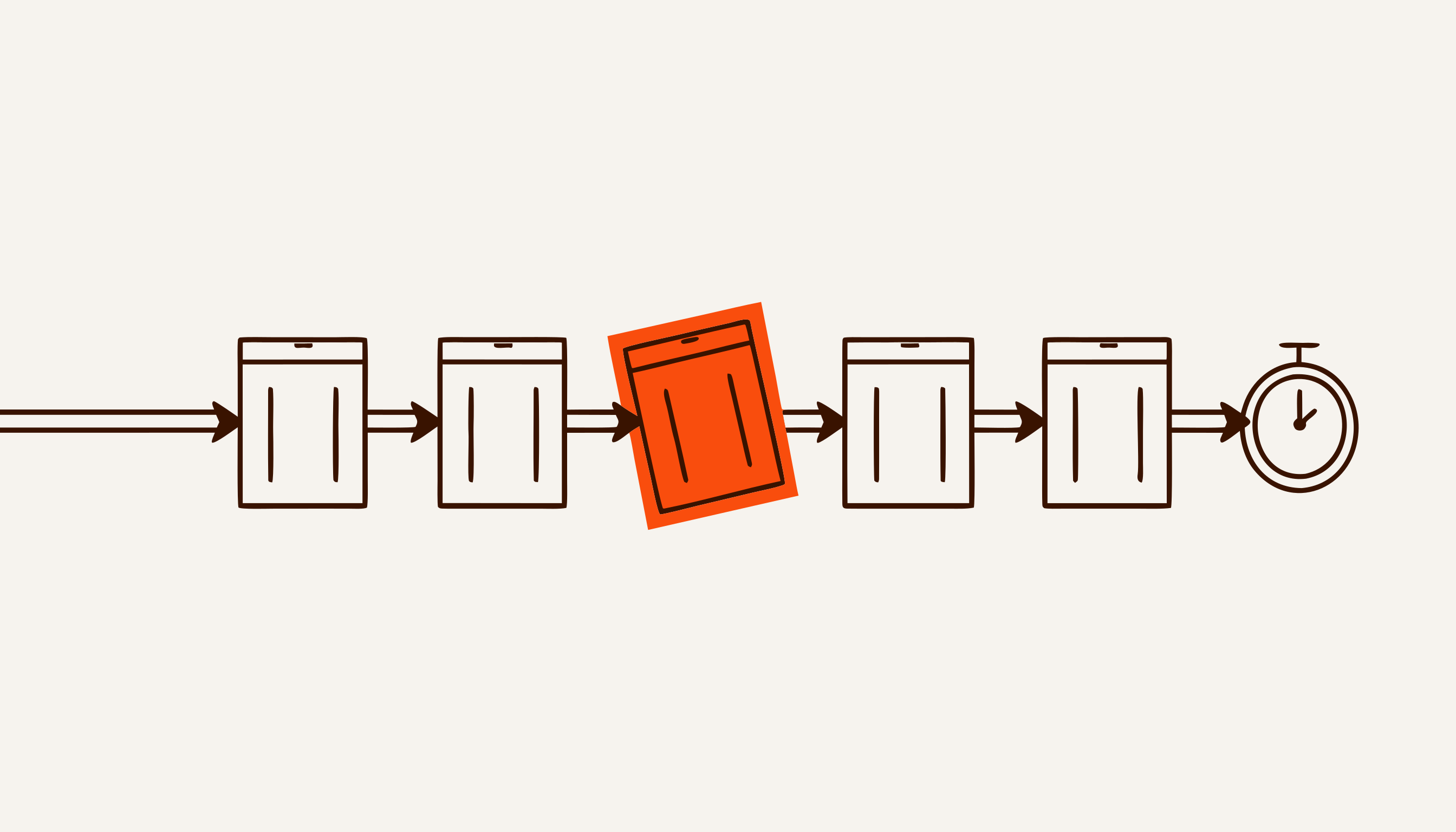
So AI business automation is not a separate product but a step in a chain: the model reads the input, rules route it, code does the sums.
Both share one limit: automation repeats a process faster, it does not fix it. As Bill Gates put it in The Road Ahead in 1995, “automation applied to an inefficient operation will magnify the inefficiency”. So redundant steps are cut before the build — see “Don’t Automate, Obliterate”.
What business automation includes
It includes any work your people do by a repeating rule: lead intake, client replies, moving data between systems, documents, reports and deadlines. By area:
- Lead intake. Website, Telegram, WhatsApp, Instagram and calls land in one queue with the source attached; nothing stays in a manager’s private chat.
- Client replies. Prices, stock, address, order status, bookings — instantly, nights and weekends included. Anything non-standard goes to a person with the conversation.
- Data between systems. Messenger → spreadsheet → CRM → 1C → report, no copy-paste — usually the biggest and dullest part.
- Documents and email. Invoices, delivery notes, contracts and emails are split into fields and checked for completeness.
- Reports. Figures from several sources, sent to the manager on schedule.
- Deadlines. Tasks by role, reminders, an alert when a stage stalls.
- Payments and debts. Payment reminders and a list of who owes what after delivery.
Our AI automation services cover more than the build. “Turnkey” means a breakdown of the process, a success metric before the start, the build and integrations, go-live, documentation, and handover of code and access; support afterwards is by subscription or in-house.
Which business processes are automated most often
The processes automated most often repeat many times a week and already run on digital data. Examples of business process automation, with where AI ends and rules begin:
| Process |
What the system does |
AI or rules |
Usual starting point |
| Lead intake |
Pulls leads from all channels into one queue, creates a deal, notifies a manager |
Routing and duplicates — rules; free text and voice — AI |
The channel with the most leads |
| First reply |
Answers on prices, stock, address and terms, day and night |
Understanding and answering from approved text — AI; handover — rules |
The 10–20 most frequent questions |
| Bookings and reminders |
Offers times, confirms, reminds, reschedules |
Mostly rules; AI to parse “can I come tomorrow afternoon?” |
A reminder the day before |
| Data transfer |
Messenger → spreadsheet → CRM → 1C, no manual entry |
Rules |
Two systems that do not talk to each other |
| Documents and email |
Extracts bank details, amounts and dates from PDFs, scans and emails |
Reading — AI; checking fields and sums — rules and code |
One document type, such as supplier invoices |
| Manager’s report |
Combines figures from several sources on schedule |
Rules; AI for a short written summary |
The report someone builds by hand weekly |
| Deadlines and tasks |
Assigns tasks by role, reminds, flags overdue stages |
Rules |
The stage where deadlines slip most |
| Payments and debts |
Sends payment reminders, keeps the debtor list |
Rules; sums are done by code, not the model |
The debtor list in a spreadsheet or 1C |
Which one goes first is an evening’s arithmetic of hours and cost of error — see What to automate first. Leads, response speed and the funnel are covered separately in sales automation.
Types of automation: one process, a chain, or your own model
Types of business automation differ on two axes: scale (one process, a chain of processes or your own model) and technology (integrations and workflows, bots, AI models, machine learning on your data).
By scale
One process. Leads from the website and Telegram reach the CRM with source and priority, and a manager is notified. Two weeks, up to three integrations — the most common first step and our Pipeline package.
A chain of processes. Three or four processes passing data along: lead → deal → invoice in 1C → payment reminder → summary for the manager. Plus your own dashboard and team training; four weeks, the Shop floor package.
Your own model. For when no ready-made model fits: valuation, forecasting, satellite imagery, geo. Our EstIQ is built this way: it prices an apartment in Uzbekistan in 40 seconds from 125,000 properties in open market data, with a median error of about 10% on resale apartments it has not seen. Eight weeks or more, the Custom package.
By technology
- Integrations and workflows: “event → processing → action” chains between systems, built on n8n and hosted on your server, so data does not pass through a middleman.
- Bots in Telegram and WhatsApp: they take requests from clients and staff, answer routine questions and hand the rest to a person.
- AI models such as ChatGPT (OpenAI), Claude (Anthropic) or Gemini (Google) read text, voice and documents, sort requests and write drafts. We pick the model for the task; the keys are yours.
- Machine learning on your data: forecasting, valuation or scoring learned from your history and tested on cases the model has not seen.
AI agents, models given tools and the right to choose their next step, are a separate case: see AI agents for business.
Automation systems: what you already have and what we add
Automation systems come in two layers: systems of record where the data lives — CRM, 1C, spreadsheets, point-of-sale and warehouse software — and tools that connect them and do the work: integration platforms, bots, AI models. Most companies already have the first; we add the second on top of it, not instead of it.
| You already have |
Typically today |
What automation adds |
| CRM: amoCRM, Bitrix24, a dealer’s OEM CRM |
Deals entered by hand; some leads stuck in managers’ chats |
Leads from all channels arrive on their own, tasks are set automatically, overdue items are flagged |
| 1C and accounting software |
Invoices, payments and stock reconciled with the CRM by hand |
Invoices, payments and stock sync without manual entry |
| Google Sheets, Excel |
One sheet is client base, order log and report at once |
The sheet feeds the bot and reports; with no CRM, start here |
| Telegram, WhatsApp, Instagram |
All client chats; replies when a manager has a minute |
Enquiries reach the queue and CRM; the bot answers routine questions, a person gets the rest |
| Telephony |
Nobody listens back; outcomes go unrecorded |
Call transcripts and a summary in the CRM |
| Point of sale, warehouse |
Only the storekeeper knows the stock |
Stock and sales feed the bot and the summary, if the software has an export or API |
No CRM, or one nobody uses, is no reason to buy a new one: we break down the process first. More on CRM implementation, n8n automation and business chatbots.
Where AI pays off and where plain rules are enough
AI business automation is justified when the input is free text, voice or a document and the answer cannot be scripted in advance. When the data sits in fields and the decision fits an “if — then” rule, plain automation is cheaper, faster and more predictable.
AI pays off in:
- free-form chats and voice notes in Russian and Uzbek;
- documents: invoices, delivery notes, contracts, emails with attachments;
- sorting requests by topic and urgency;
- draft replies and knowledge-base search.
Rules are enough for:
- moving data between systems;
- reminders, statuses, deadlines and scheduled reports;
- sums, price-list discounts and debts — a job for code, not the model.
A third zone is decisions that change a client’s position: a refusal, a discount beyond the price list, a refund, an instalment plan. A person makes those. For legally significant decisions this is also the law: since January 2026, a decision affecting a person’s rights and freedoms may not rest solely on the conclusions of AI (Article 7¹ of the Law on Informatization, added by ZRU-1115). More in our breakdown of the AI law ZRU-1115; the rules, fines and figures, each with its primary source, are collected in our AI in business in Uzbekistan reference.
There is no single best model “for business”: Uzbek voice notes, delivery-note fields and client replies are each won by different models, on quality and on price. How to choose one and what AI costs to run: AI implementation for business.
Which businesses can be automated
Any business with a repeating process can be automated: the same action by the same rule at least a few times a week. The industry matters less than it seems — a car dealership and a clinic use different words but the same mechanics: answer at once, see it through, show the manager where things are stuck.
Five industries have their own pages with demos:
- Car dealerships: a reply to every lead within a minute, test-drive booking, manager control around the OEM CRM.
- Housing developers: night and weekend answers to buyers from your availability chart, viewing bookings.
- Clinics and dental practices: bookings, reminders, answers on prices and preparation; anything medical goes to a doctor.
- Accounting firms: client requests in Telegram become complete tickets; deadlines stay on track.
- Manufacturers: orders from Telegram and calls on one board, shop-floor reminders, balances due after delivery.
Small business automation
In a company of 3–10 people, processes rest on the owner, who answers clients in Telegram, remembers who owes what and totals up sales in a spreadsheet. Automation starts with one bottleneck rather than a CRM — usually client replies and bookings — and a spreadsheet is a perfectly good base. Our Valli bot is one example: it handles client conversations in Telegram and hands anything non-standard to a person; it is currently in a pilot.
It can also be too early: a process that runs less than weekly will not repay the support, one about to change means paying twice, and if a ready-made service does the job in two days, we will say so instead of building it.
How much business automation costs in Uzbekistan
With us, one process end to end costs from $1,200 plus $300 a month; a chain of three or four processes, from $6,500 plus $700 a month; your own model on your data, from $18,000 plus $1,200 a month. Package details are in the pricing block below.
Within these ranges, the price depends on:
- Integrations. Each system means access, an API or export, a data format and failure handling.
- Data sources. A tidy spreadsheet and a thousand uneven scans are different amounts of work.
- Languages. Russian, Uzbek in Latin and Cyrillic script, English, voice: more languages need more test examples.
- Volume. A hundred requests a month and ten thousand mean a different load and model bill.
- Data requirements. Your own server, fields that must not reach the model, an NDA.
Prices are per project, not per hour. The monthly fee covers monitoring, repairs when a data source breaks, and changes. You pay for CRM licences, the server and model usage on your keys directly to the providers; we make nothing on them. No discounts: a smaller budget means a narrower scope. You can pay in UZS at the Central Bank rate on the invoice date.
For reference: in September 2026, public price lists in Tashkent and Samarkand put a customer-facing bot at about $1,000 and up to launch plus $400–600 and up a month (how to compare offers).
Part of the cost may come back. On 18 August 2026 the President announced the “Artificial Intelligence — Partner for 10,000 Enterprises” programme, compensating enterprises for 50% of AI implementation costs. As of late September 2026 no payment procedure has been published, so who qualifies and for what is unknown; see 50% of AI costs reimbursed. We will not promise half the cost back before the rules exist.
AI automation services: how we differ
Three things set us apart: the success metric goes into the contract before the start, and if we miss it, the stage is not paid; the code and data stay with you; and we build on top of your CRM, 1C, spreadsheets and messengers instead of replacing them.
- Your code and data. The server, n8n and model keys are yours. We do not take your database, resell it or train anything unrelated on it — a separate clause in the contract. What goes to the model is recorded in the spec; the NDA comes before any data.
- Three languages. Russian, Uzbek in Latin and Cyrillic script, English and voice notes; each client gets replies in their own language.
- Who we are. A software developer and IT Park Uzbekistan resident: “AI CAPITAL FACTORY” MChJ, tax ID 313270615, registered in Samarkand; we work in Samarkand and Tashkent, and online elsewhere. A team of 13; the founder, Amir Negmatullaev, breaks down client processes personally.
We turn down jobs where success cannot be measured or a ready-made tool does it in two days, and we do not sell “AI implementation” without a named process and metric, or websites and design as a separate service.
We have no client case studies with numbers yet: the company was registered in August 2026. Instead of other people’s logos, here are our own running systems:
- Valli handles client conversations in Telegram and hands anything non-standard to a person; it is currently in a pilot.
- CorpVisor keeps track of the process at a manufacturing company in Samarkand: tasks by role, reminders, replies to clients, prepayments and balances due after delivery, a morning summary for the manager.
- SUV AI tells a farmer every morning when to irrigate and how much water to apply. Stage 5 of 5; the first paid contract covers 100 hectares at a large farm.
- Four more Lab products, stages stated honestly: EstIQ, apartment valuation (3 of 5); LOVEC, which finds people asking out loud about buying property (3 of 5); KONTUR, satellite crop monitoring (2 of 5); KARTOCHKA, Uzum seller listings (2 of 5).
How to choose a business automation company
Choose by the answers to four questions, not by the website — every website says “turnkey AI”.
- Which process do you propose first, and why? A good answer names one process with numbers: how often per week, how many hours, what an error costs.
- What metric will show it worked — and what if it does not? The metric is fixed before the start; the consequences go into the contract.
- Who owns the code, access and data? You do. Ask for access in week two, not at the end.
- What is the total cost? Launch, the monthly fee and what that fee covers.
The full eight-question checklist, with contractor types, legal checks and personal data, is in Business automation companies: how to choose one.
Where to start
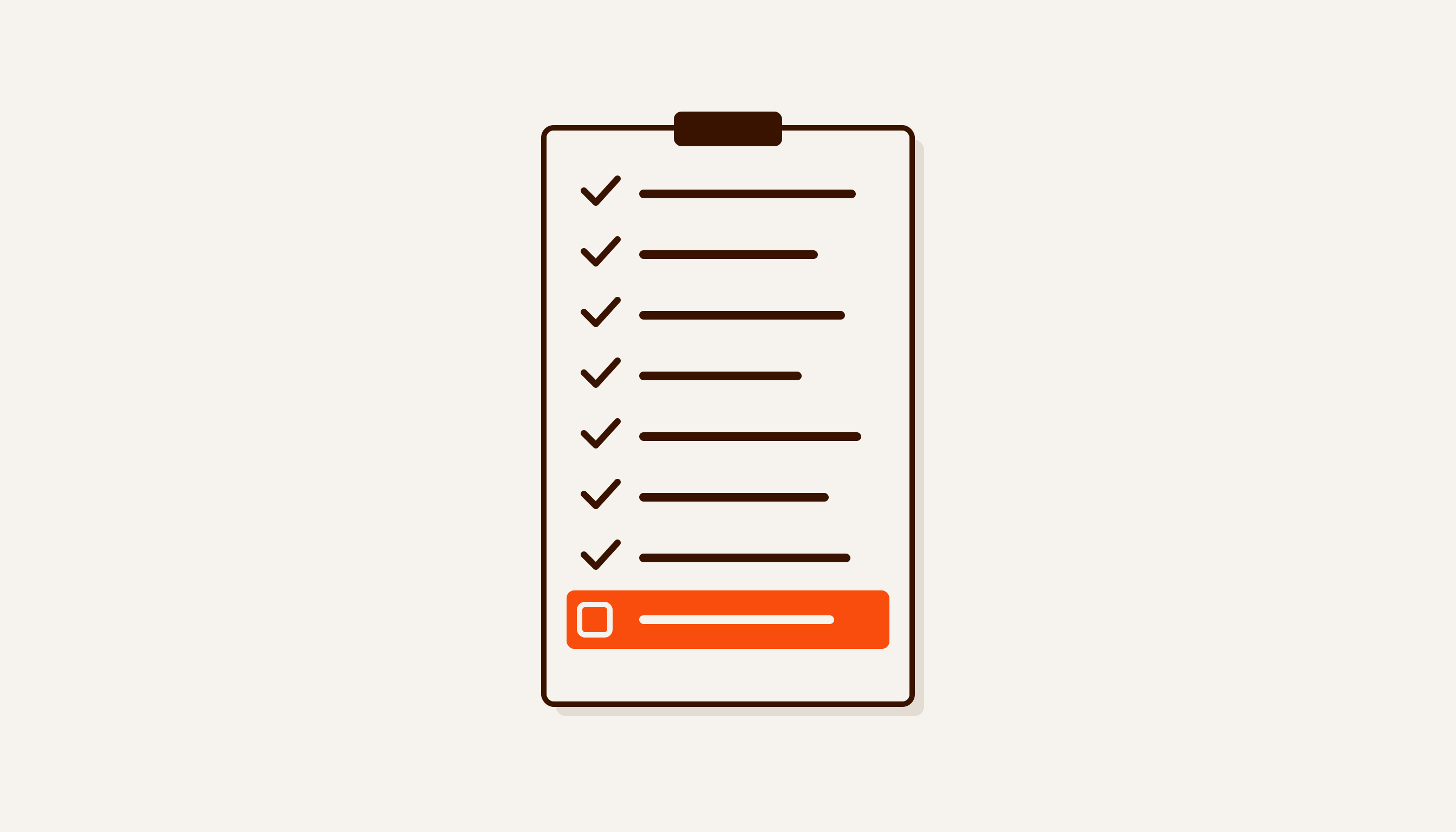
Start with one process: write it out step by step, count the hours and the cost of error, and fix the metric that will show the automation worked.
- Write the process out as it actually runs. One line per step: who, where the data sits, how long.
- Count. For each step: times per week, minutes, cost of an error. Automate first where “hours × cost of error” is largest and the data is already digital.
- Fix the metric before the start. One sentence, such as “time to first reply drops from 40 minutes to 5” — otherwise “it feels easier” replaces the result.
The detailed plan is in How to automate your business: a step-by-step plan.
For an outside view, describe your process in the quiz: six questions, and within 48 hours a map of what to take off people first, in what order and at what cost — free, no call needed. Or order business automation straight away on Telegram; we will still start with the audit.