A 2030 target and the first rules
In October 2024 the President approved the Strategy for the Development of Artificial Intelligence Technologies until 2030 (Resolution PP-358). Its targets are set in numbers: AI-based software and services worth up to $1.5 billion, up to 10% of services on the Single Portal of Interactive Public Services delivered with AI, up to 20 research laboratories, and a place in the top 50 of the Government AI Readiness Index.
The figure of “100 projects” is not in the strategy. The President named it in his Address to the Oliy Majlis on 26 December 2025. After announcing four data centres, two supercomputers and AI laboratories at 15 universities, he said this would “serve the implementation of more than 100 artificial intelligence projects in such important areas as medicine, transport, agriculture…” (here and below, translations of quotes are ours).
On 21 January 2026 the President signed Law ZRU-1115. It amends several laws at once and took effect on the day of publication. For a bot that talks to customers, three of its provisions matter: the definition of AI, the limit on decisions, and a new fine for personal data.
What the law calls AI, and what it forbids
The definition was added to Article 3 of the Law “On Informatization”. In the Russian version on lex.uz, AI is a set of technological solutions that makes it possible “to imitate human cognitive functions (including self-learning and searching for solutions)”. The Uzbek text speaks of imitating human knowledge and skills and of getting results comparable to human intellectual activity. A bot that reads a customer’s question and writes the answer itself fits that description, on our reading.
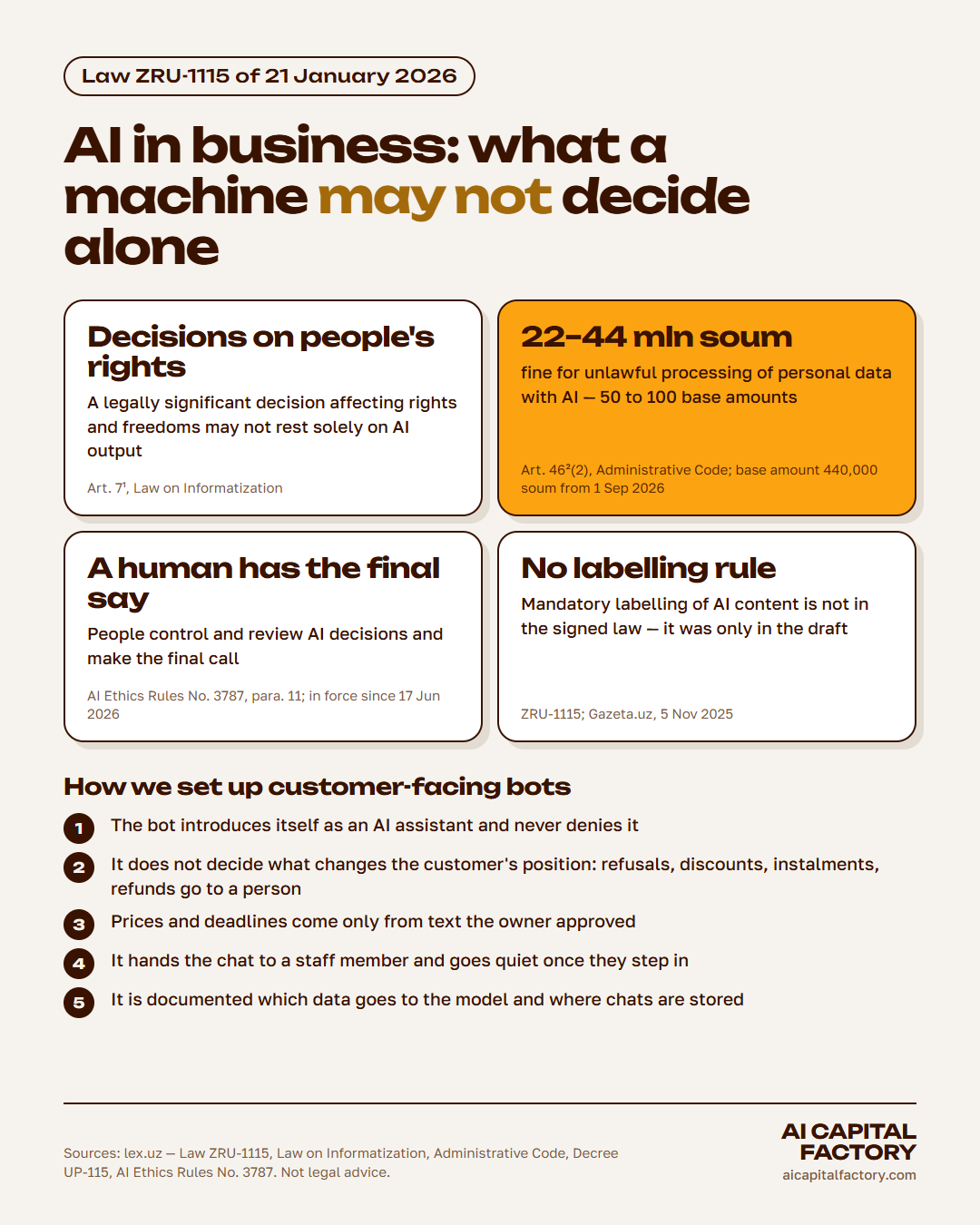
The ban sits in the new Article 7¹ of the same law. When legally significant decisions affecting human rights and freedoms are made, “it is not permitted to rely solely on the conclusions of information resources and information systems created on the basis of artificial intelligence technologies”.
The provision turns on the word “solely”. Read literally, it lets AI prepare a decision: collect the data, sort the requests, suggest an option. What it forbids is the system’s output becoming the decision with no person in between.
We found no list of legally significant decisions in the provision. For a sales or support bot, we count anything that changes the customer’s position: refusing a refund, turning down instalments or credit, blocking an account. A question about delivery costs hardly qualifies.
The fine: 22–44 million soum, not 20.6–41.2
ZRU-1115 added a second part to Article 46² of the Code of Administrative Responsibility. Unlawful processing of personal data using AI technologies, or spreading such data through the media, telecom networks or the internet, now carries a fine of 50 to 100 base calculation units (BCU), with confiscation of the instruments of the offence. This part sets no separate rates for citizens and officials.
Summaries of the law quote 20.6–41.2 million soum. That sum uses the previous BCU of 412,000 soum. Since 1 September 2026, under Decree UP-115, one BCU is 440,000 soum, and the same range comes to 22–44 million.
For comparison, take part one of the same article, in the Code’s text on lex.uz as amended by Law ZRU-726 of 2021. It covers unlawful collection, systematisation and storage of personal data. Under it a citizen pays 7 BCU (3.08 million soum) and an official 50 BCU (22 million). Once the data was processed with AI, the minimum fine for a citizen is more than seven times higher.
A repeat violation of personal data law after an administrative penalty leads to Article 141² of the Criminal Code. In the 2021 wording, according to Gazeta.uz’s breakdown, that means a fine of 100 to 150 BCU, deprivation of a specific right for up to 3 years, or corrective labour for up to 2 years. With aggravating circumstances, it goes as far as up to 3 years in prison.
For a bot, this article is about the chat log. Names, phone numbers and addresses from a dialog end up in the model, in logs, in spreadsheets. Part two does not spell out what counts as unlawful processing. On our reading, the answer lies in the Law “On Personal Data”. The terms on which customer chats may be passed to an external model are covered in a separate breakdown.
What the law does not contain
A common mistake in summaries is to claim the law introduced mandatory labelling of AI-generated content. The signed text has no such rule. The bill did. According to Gazeta.uz’s report on the Senate approving the law in November 2025, the draft required anyone uploading AI-created information resources to label them. The same report mentions administrative arrest of up to 15 days, alongside the fine, for personal data violations. The text of ZRU-1115 on lex.uz contains neither labelling nor arrest.
No duty to label does not make an “AI is replying” note pointless. The reason is in the ethical rules.
Ethical rules: the final decision stays with a person
On 14 March 2026 the Ministry of Justice registered, under No. 3787, the Ethical Rules for Creating, Implementing and Using AI-Based Solutions. They were approved by Order No. 284-mh of the Ministry of Digital Technologies, dated 24 February 2026, and took effect on 17 June 2026, three months after publication. lex.uz carries only the Uzbek text.
Item 11: all decisions made through AI technologies and systems must be under human control and reviewed by a person, and “the final decision must be made by a human”.
Item 10: users are told that AI decisions are not always correct and that their results may be used for advisory or reference purposes.
Item 6: AI decisions should not be accepted as final.
Put next to Article 7¹, this forms one structure. The law forbids relying on AI alone when a decision affects a person’s rights. The rules go wider: a person reviews AI decisions in general, and the user is told the system can be wrong. You cannot tell that to a customer who does not know they are writing to a bot. So we build an “AI is replying” note into our own bot from the first message, even though the law does not ask for it.
A pre-launch checklist for a bot
This is what we check on a sales or support bot before its first live dialog. Some items follow from the rules, some from our reading of them. Where the text is silent, we take the stricter option.
- The bot introduces itself as an AI assistant in its first message and does not deny it when asked directly.
- The bot does not decide anything that changes the customer’s position: a refusal, a discount beyond the price list, instalments, credit, a refund. It collects the details and hands the dialog to a person.
- Prices, deadlines and terms come only from text the owner has approved. With no answer there, the bot says it will check. Liability for a promise the bot should not have made is covered in a separate breakdown.
- The handover works both ways: a staff member gets a signal, and the bot goes quiet once a person joins the conversation.
- It is written down which personal data goes to the model, which provider runs it, and where and for how long chats are kept.
Items 1, 3 and 4 are built into Valli, our auto-responder for Telegram Business, which is currently in pilot. In its first message Valli introduces itself as the owner’s AI assistant; asked “are you a bot?”, it says yes. It quotes prices and deadlines only from the owner’s profile, and when the profile has no answer it says it will check with the owner. A hot dialog reaches the owner as a card with a button that silences the bot in that chat for 24 hours. If the owner writes in a customer’s chat themselves, the bot stays out of that chat for two hours.
The introduction, the honest answer and the profile-only prices are instructions to the model, not restrictions in code, and the model can drift from them. The pause after the owner writes is enforced in code. How often the model breaks its instructions in live dialogs is for the pilot to show.
An infographic to share
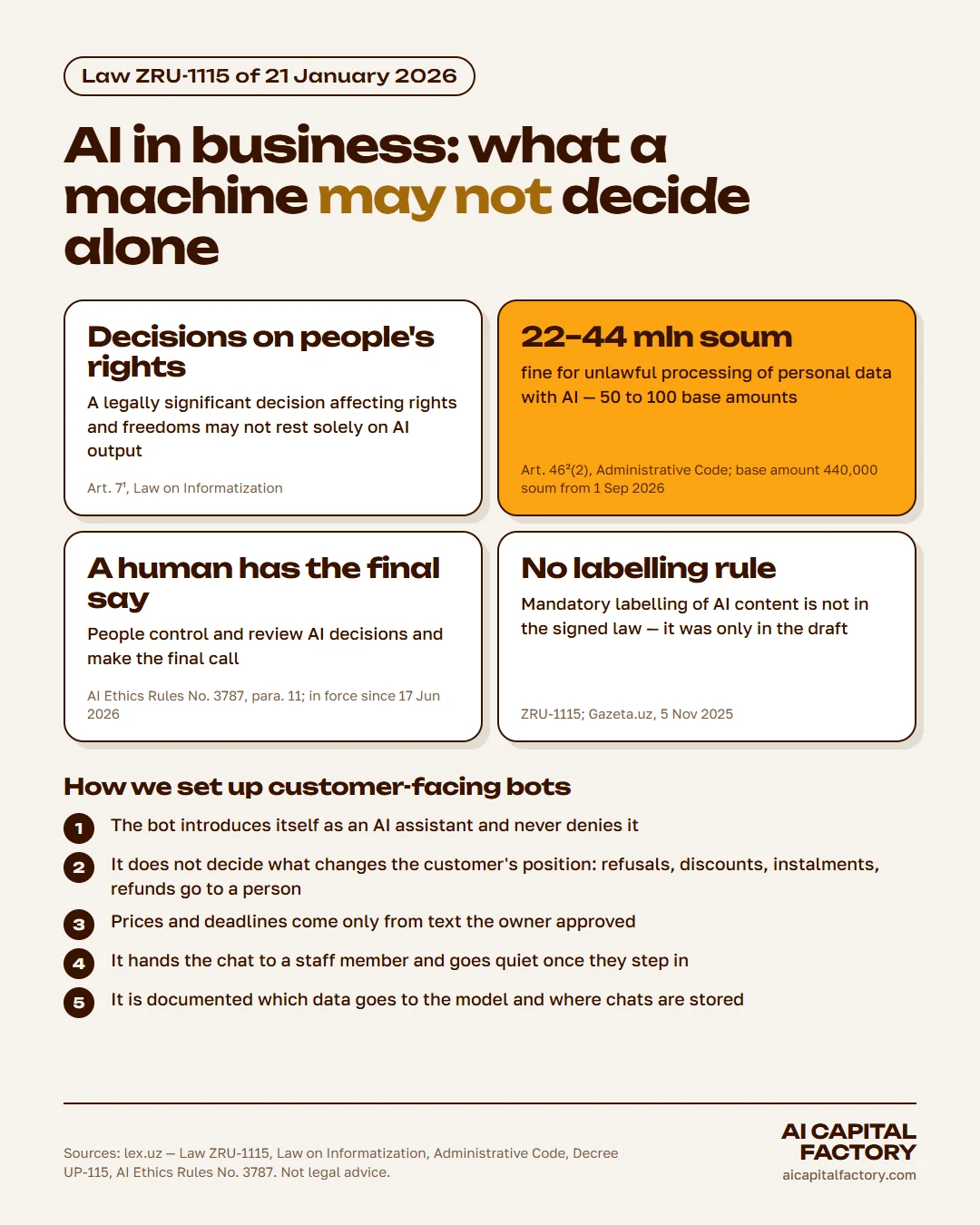
More numbers on AI in business in Uzbekistan — the 2030 strategy, the compensation programme, measured response times — are collected in our fact sheet with primary sources.
What we don’t know
This is not legal advice. We read these rules while setting up our own bot and describe them as we understood them. Check any decision about your business with a lawyer.
On lex.uz, ZRU-1115 is published in Uzbek only. The Russian wording of Article 7¹ and of the AI definition comes from the consolidated Law “On Informatization” on the same site; the English renderings are ours. We found no official Russian or English text of the ethical rules.
The text does not tell us which decisions the law treats as legally significant, or whether Article 7¹ covers bots run by private businesses. Items 6, 10 and 11 do not show who the ethical rules are addressed to, or whether breaking them carries any liability.
The amounts under part two of Article 46² come from the text of ZRU-1115; we have not seen the full consolidated wording of the article after the 2026 amendments. We did not establish at what stage labelling and arrest dropped out of the bill. The penalties under Article 141² of the Criminal Code, in the 2021 wording, rest on NORMA.UZ and Gazeta.uz; we did not open the Code itself. We did not check the previous BCU of 412,000 soum against a primary source. We found no enforcement practice for the new fine.
How we apply these rules in projects — what goes to the model, where the data lives, where a person makes the decision — is on our page about AI implementation in Uzbekistan.
If you want to split your customer correspondence into what can go to a bot and what stays with a person, describe the process in the quiz. We break down one process for free within 48 hours, with no intro call.