

Manufacturing automation from order to payment

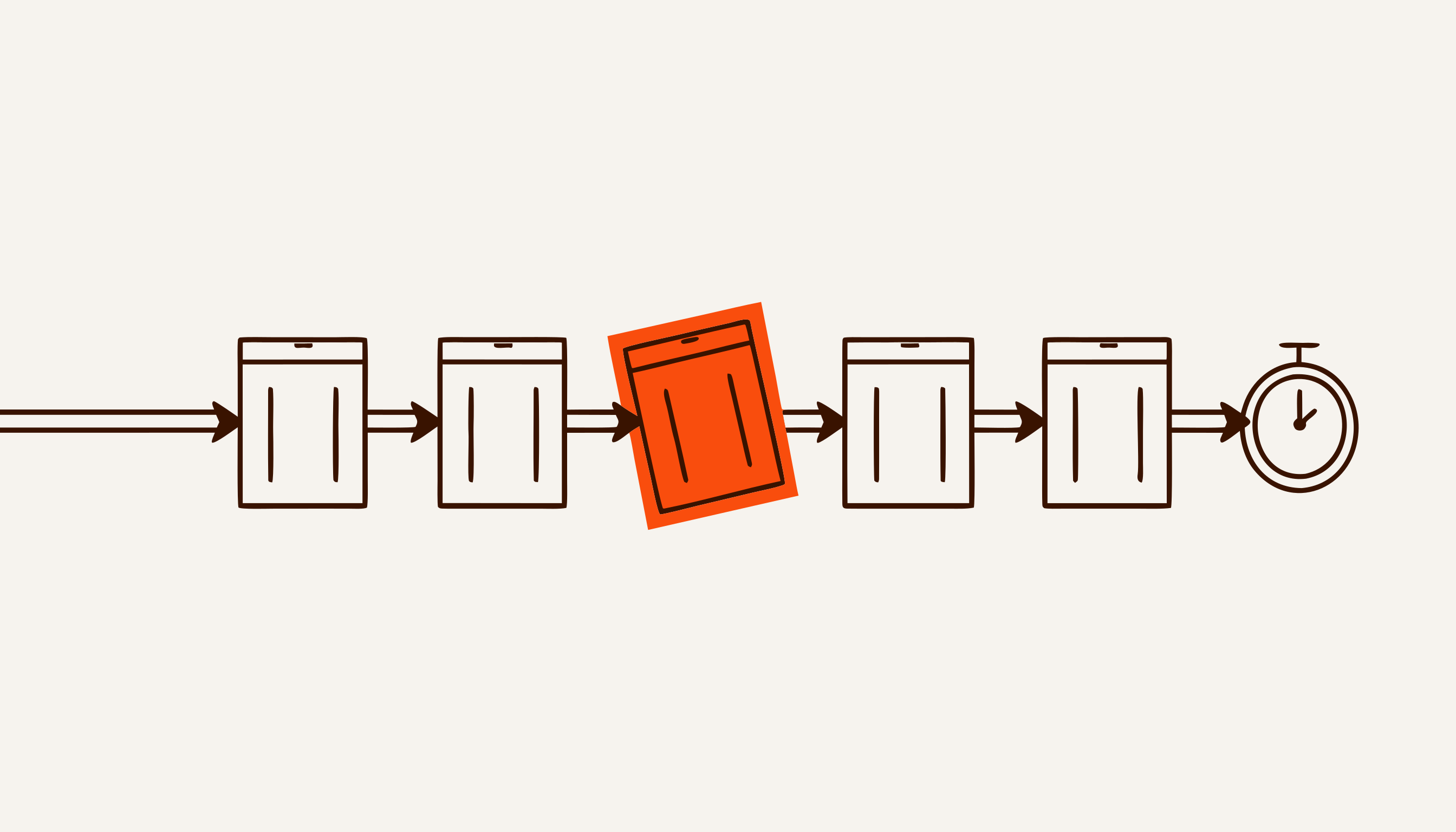
Orders from Telegram, the manager's private chats and phone calls land on one board. Clients get answers and order status without waiting for a manager, every stage on the shop floor has an owner and a reminder, and at 8:00 the director sees what is overdue and how much is still owed after delivery. It all runs in Telegram, which your team already uses — no new ERP needed.

48 hours
to audit one process at your factory — free, no intro call
2 weeks
for the pilot: one link of the chain live, the metric fixed before the start
8:00
morning summary: what is overdue, what is stuck, what is owed
3 languages
to talk to clients in: Russian, Uzbek and English

Where an order gets stuck between the manager and the shop floor

An order is taken in Telegram, over the phone or by word of mouth in the shop — and lives in the manager's head and a notebook. The client calls: "Where is my order?", the manager walks to the shop, the foreman says: "Nobody told me." The owner hears of a missed deadline from the client, and the balance after delivery is promised "next week" — a month later nobody remembers who owes what.

The system here is not "yet another program for the shop floor" but an attendant on the whole chain: it takes the order, answers the client, hands out tasks by role, sends reminders and alerts the director when a stage stalls. A model reads messages, voice notes and photos; code does the sums. Your 1C or accounting software stays: data moves by export, via API or as a ready card — we pick the route for your system during the audit.

Factory bot — demo online 24/7
Hello! I need a metal canopy, 4 by 3 metres, with installation.
Hello! Noted: 4 × 3 m, with installation ✓ The measurer will check the size on site. When would suit you for the visit?
Tomorrow after 15:00
Passed to the measurer: tomorrow after 15:00 ✓ I will write as soon as the time is confirmed. The exact price comes after measuring. Order number: A-1042.
→ task for the measurer, order on the board under "Measuring"

This is not a video: pick a scenario and watch the bot run the dialogue. The second one is in Uzbek — that is how the bot talks to customers who prefer it.

What the system takes over

All orders in one place

A bot link, the manager's private chat, a phone call (the manager logs it) — every order gets a number and a card. If a caller later writes in Telegram and gives their phone number, the cards merge.

Answering "where is my order?"

The bot knows the stage and payments and answers at once. At key moments it writes first: measuring booked, offer with price and deadline, in production, ready to install.

Stages and owners

A task goes to a role — measurer, process engineer, foreman; the first to tap "Take" owns it. Unclaimed — a reminder, then the director. The log shows who stalled it.

Preliminary quote from dimensions

The client writes "3 by 2" — code parses the size and prices it at the rates you set. No rate, no figure from the bot. The manager confirms the total after measuring.

Deposits and unpaid balances

The client sends a receipt — a photo or a banking-app screenshot; the bot recognises it, the manager confirms. Bank transfers are marked by hand. Partial payments, the balance and a printable slip sit in the order card; debts after delivery go to the dashboard and the morning summary.

8:00 summary and order board

Each morning the director sees what is in progress, overdue, stuck over two days and owed after delivery. The dashboard has the order board, debtors and 7-, 30- and 90-day reports.

Why it takes root on the shop floor

Telegram instead of new software

Foremen don't have to learn a new system: the task arrives in Telegram, they tap "Take", close it with one button and send photos straight from their phones. The bot understands voice notes too.

A pilot on one link

We start with one link — say, "where is my order?" calls or debts after delivery. The "before" metric is fixed in writing before the start; miss it — the stage is not billed.

People sign off on dates and money

The bot never names deadlines on its own, never gives discounts and never accepts a smaller prepayment. Code does the sums at your rates; the manager approves the total and the deadline — the bot only passes them on.

What you can see live

The demo at the top of this page is a simplified copy of our working systems. CorpVisor runs orders at a manufacturing company in Samarkand: tasks by role, reminders, client replies, preliminary quotes at the company's rates, prepayments and post-delivery debts. The Valli bot answers customers in Telegram and hands anything non-routine to a human — it is currently in pilot. At the meeting we show the dashboard, order board and morning summary at work, not on slides.

The path of one order

  1. 01 Order received From Telegram, the manager's chat or a phone call. Number, dimensions and photos go straight into the order card.
  2. 02 Quote and prepayment Preliminary at your rates; the manager approves total and deadline; prepay by receipt or transfer.
  3. 03 Shop floor and stages Tasks by role, reminders, an alert to the director. The client sees the status without calling.
  4. 04 Handover and payment The balance is paid at handover. If not, the debtor shows in the dashboard and the total owed in the 8:00 summary.

Stages for your shop are set up during the pilot. There is no need to take the whole chain at once: first one link, the rest once the first has proven itself in numbers.

How the work is organised

48 hours

Audit

We break one of your processes down step by step and hand back a map: what can be taken off people, in what order and what it costs. Free, and no intro call.

2 weeks

Pilot

We build one pipeline and run it live. The "before" metric is fixed in writing before the start, not invented afterwards. If we do not hit it, the stage is not paid for.

After that

Handover

The code, the access and the documentation are yours. Everything lives inside your own perimeter. Support by subscription or with your own hands — your call; we do not keep you on a hook.

What it costs

A price per project, not per hour. The first audit is free: six questions, an answer within 48 hours, no intro call.

from $1,200

Pipeline

One process end to end: data collection, processing, notifications, reporting. Up to three integrations.

2 weeks

Timeline

+ $300 per month

Pilot

What is included

One link of the chain end to end: stages and roles set up, launch, two weeks live and a report on the metric. Telegram bots are free; Telegram Premium is needed only by a manager whose clients write to them privately.

Frequent questions

We run 1C or our own software. Will we have to replace it?
No. 1C or your software stays, and no new ERP is needed. How data moves — by export, via API or as a ready card — we decide during the audit, after looking at your system. If your client and debt records are kept in a CRM or in Excel, our team moves them over at launch.
Our shop floor uses a Telegram group. Is that a problem?
No. Tasks go to each person privately in Telegram and close with a button: in a group an instruction drowns in the feed, in private it has a deadline and an owner. Keep the group for talk. Staff menus are in Russian for now.
Who works out the price the bot gives a client?
Prices are calculated by code at your rates, not by the model. No rate — the bot names no figure and calls the manager. The quote is marked preliminary; the manager approves the total after measuring.
What about our data and prices?
Orders, rates, payments and debts stay inside your perimeter: keys, access, code and documentation are yours — a separate contract clause says so. The model reads messages, voice notes and photos; code does the sums at your rates.

Read next

A stack of spreadsheet pages with a grid, a funnel beside them and an arrow leading to a phone; on the screen an orange message bubble with five lines, and next to the phone a clock whose hands show eight
Automation · 16 min read

How to automate business reports: from Monday copy-paste to a summary that sends itself

How to automate reports without speeding up your mistakes: keep the 3–5 numbers someone actually acts on, guard against silent limits like the old XLS format, and pick one of four levels — Power Query in Excel, Google Sheets with Apps Script, a scheduled summary in Telegram, or BI. Where AI belongs in reporting, a five-line summary template and a checklist.

Show your process — I will send back an automation map in 48 hours

Six questions about how things are set up at your place today. The output is a diagram: what can be taken off people, in what order and what it costs.