
The price of one cold message
In the UAE, cold outreach is not a grey area. It is a violation with a known price. Under UAE Cabinet Resolution No. 57 of 2024, an individual marketing from their own number faces a Dh5,000 fine and the cutting of every number registered in their name until the fine is paid. A repeat within 30 days means Dh20,000 and three months cut off; a third time, Dh50,000 and a year without telecoms services. Resolution No. 56 counts not only calls but also marketing text messages and messages through social media applications as telemarketing.
The second part hurts more than the first. A fine is money once; having your numbers cut off means losing all your working correspondence — active clients, partners, negotiations in flight. For an agent who lives in a messenger, that is a stoppage, not an expense.
What follows is not “be more careful with the blast”. It is reversing the direction of the first message. The client has to write first.
How to reverse the direction
The difference between a cold contact and an inbound one is not the politeness of the text. It is who started the conversation.
There is one way to reverse it without an advertising budget: find publicly stated intent. Someone asks out loud, in an open chat or a forum, about buying, renting, a mortgage, a district. That is not personal data from a purchased list — it is a question asked in public and addressed to everyone.
From there a simple rule applies: answer in the thread, not in direct messages.
A reply in a public chat is a public remark in a public conversation. A private message to the same person is a contact they did not request. On our reading, legally these are two different things, and the first one contains no telemarketing. That is an interpretation, not a rule: the ban on individuals has no explicit exception for contact the consumer asked for.
Then they write first. Then you handle it as an inbound enquiry.
Why it also converts better
The side effect is a pleasant one. Someone who asked a question today is at a different point of the journey than a phone number from a list bought six months ago.
Three consequences:
- Freshness. The intent is current — not “someday”, but now.
- Context. The question already carries a budget, a district or a deadline — the things a cold contact spends three messages establishing.
- Permission. They started it. Being answered is not an intrusion.
What has to be built
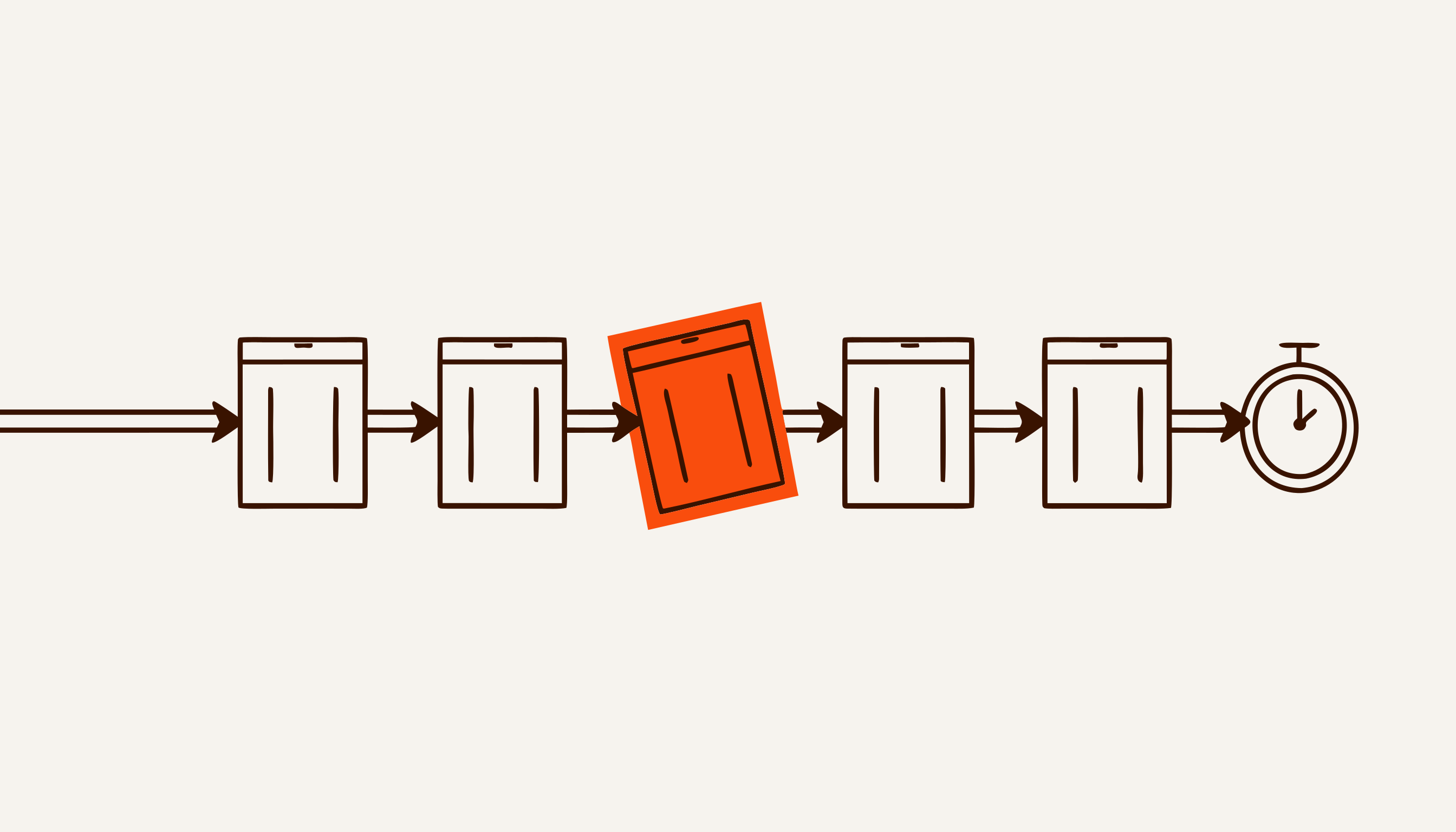
This is not “install a bot”. It is a five-step pipeline, each step verifiable on its own:
- Collection. The public places where buying gets discussed.
- Filtering. Throwing out what is not a question: listings, spam, news chatter.
- Scoring. How likely this is a genuine buyer.
- Deduplication. One person asking in three chats is one person, not three leads.
- Digest. Today’s list, sorted by score.
On our test sample of 15 messages the score ranges look like this: the seven buyers score from 56 to 128, and all eight noise messages score 0. The cut-off sits at 25: it lets through all seven buyers and none of the noise. The sample is small, so this is a check of the setup, not a measurement of accuracy.
The bug that would have cost half the leads
A note on scoring, where nearly every first implementation walks into the same trap.
Negative signals cannot all count the same. They come in two kinds:
- hard — “for rent”, “for sale”, an agency name. That is not a buyer, that is an offer;
- soft — for example, the person left their own contact details in the message.
Apply the soft ones to everybody and here is what happens: a genuine buyer who wrote “looking for a two-bedroom in this area, here’s my number” gets penalised and drops out of the results. The system discards the most motivated people — the ones who volunteered a phone number.
The correct rule: soft signals apply only to weak signals. On a strong signal, a volunteered contact is a plus, not a minus.
We caught this in our own engine before its first live run. Half the leads it was supposed to find were quietly missing from the digest — and without inspecting the discarded messages one by one, it would simply have looked like “not many leads in this market”.
What this does not solve
The approach does not replace advertising and does not scale indefinitely: there are exactly as many public questions per day as people asked. It is a queue, not a stream, and it is finite.
Nor does it lift the requirements on what happens after your first reply. Personal data rules start applying the moment a contact is in your hands, regardless of how it got there.
The engine described here is built and handed over, but it has not had a live run yet. Everything above is about how it works and what the market rules are — not about results that do not exist yet.