
What arrives on 8 November
Law ZRU-1163 takes effect on 8 November 2026 and introduces three things at once:
- certification of realtors — a certificate is required of a realtor working in a realtor organisation, and within the organisation it must be held by the head and by at least two staff members; a real estate agent, meaning a sole trader or a self-employed person, works without one, but only once entered in the registry and with liability insurance (Articles 16, 18–20);
- a single registry — an open list of realtors, organisations, agents and professional associations, kept by the State Assets Management Agency (Article 17);
- multiple listing — a system through which market participants exchange information on properties. Under Article 30 it is organised by the private sector, and its requirements are set by a national standard.
The first two are an entry barrier and a headcount. Unpleasant, but straightforward: get the document, land on the list, carry on. The third does not oblige anyone to work through a listing service: under Article 36, deal details go into the system only if the service was provided through it. But it is the part that can change the mechanics of the market, and the part most people underestimate.
Why the listing service matters more than certification
Today an agency’s advantage has a simple wording: “I have a property you don’t.” That holds exactly as long as properties are scattered across portals, chats and notebooks.
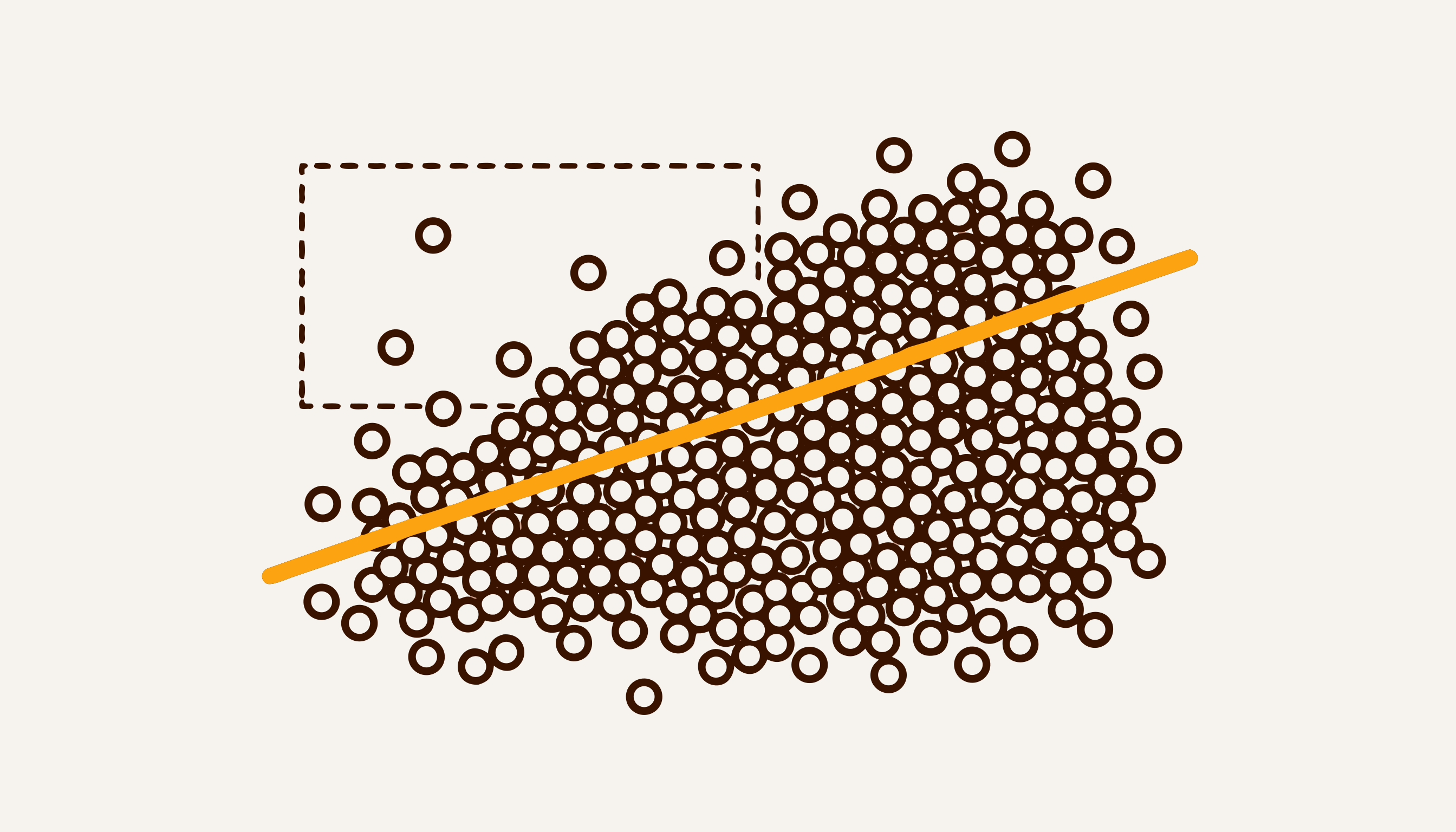
How scattered they are shows up in the numbers. From one large open listings platform in Uzbekistan we downloaded 104,235 for-sale housing listings. After cleaning, 76,862 remained, and after merging duplicates, about 62,000 properties: roughly one listing in five repeats an apartment that is already listed. The owner or the same agent reposts it, or a neighbouring agent lists it too, sometimes at a different price.
How we counted. This is a snapshot of one platform on 22 August 2026: duplicates were merged by a single rule, and 30 random groups were checked against the originals by hand. The details of how we counted duplicates are in our piece on automated apartment valuation.
A shared listing service, if the market takes it up, removes those repeats. Once a property exists once and everyone can see it, competition moves from “who has it” to “who answered first and showed it better”. That is a different profession, and it needs something other than connections: speed, and order in your data.
What it means for a five-person agency
Three consequences that follow from the structure of the law itself.
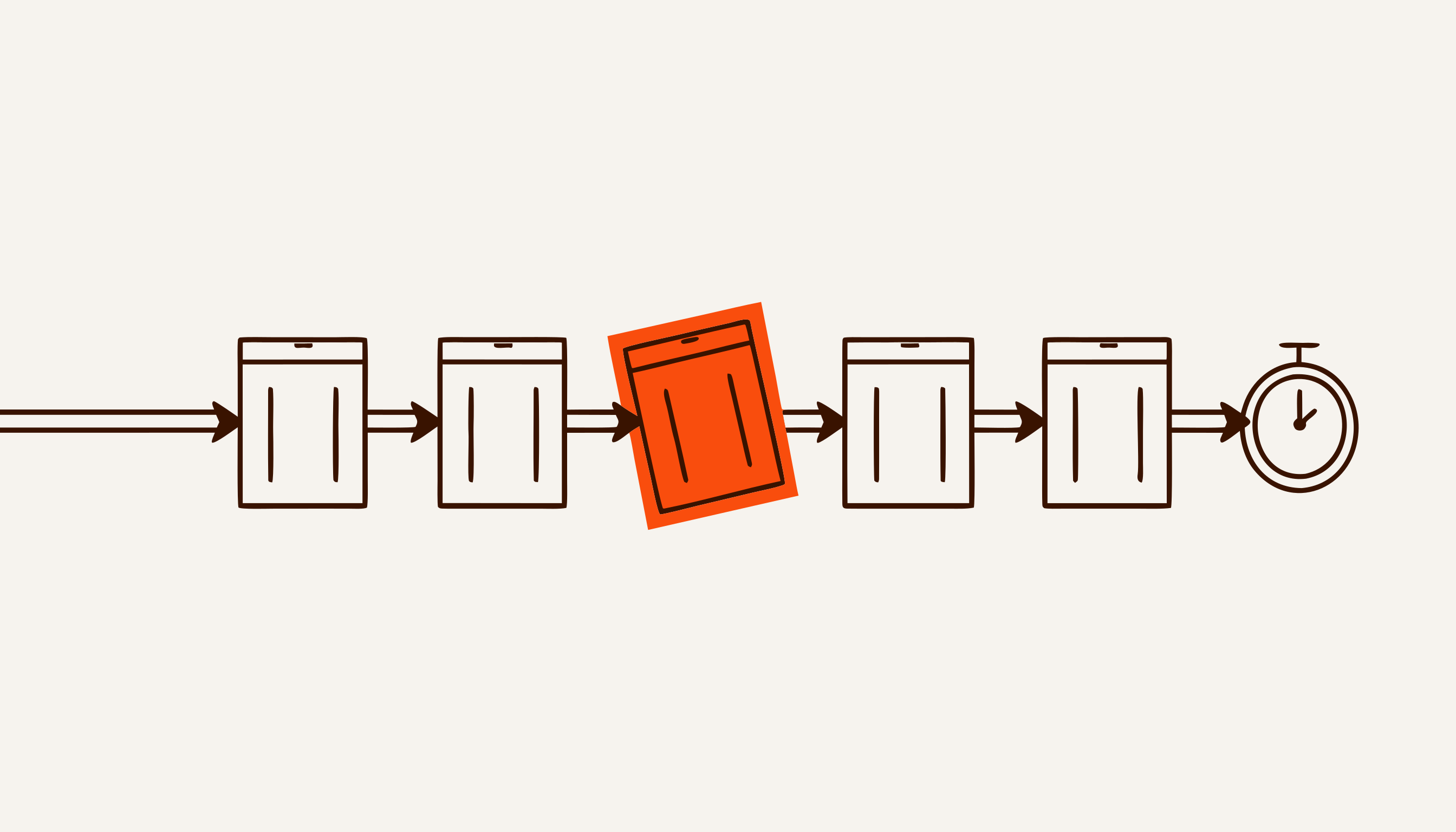
Response time becomes the product. If everyone can see the property, the agent who calls the buyer back first wins. Not the one with the better relationship with the developer.
Price stops being a blind negotiation. When a property’s history sits in a shared database, “the owner is asking this much” gets checked in a minute. The argument becomes your justification of the price, not the confidence in your voice.
Messy data becomes visible. A database that lives in WhatsApp threads and in the head of your senior agent is not a database. While it stays that way, it will have to be typed into a listing service by hand, property by property, in a hurry.
Valuation: a manual step that does not speed up with the market
In the first half of 2026 Uzbekistan saw more than 171,000 property sale transactions, 25% more than a year earlier (according to CERR). Over the same six months banks issued 13.1 trillion soum in mortgages, almost 39% more.
By law, a valuation is mandatory when state-owned property is involved in a deal, and otherwise when the value is disputed, including in mortgage lending (Article 11 of the Law on Appraisal Activity). The mortgaged property is valued by agreement between the parties or by an appraiser (Article 10 of the Law on Mortgage), but in practice banks require an appraiser’s report for a mortgage. It is done by hand: appraisers’ published prices run from 150,000 to 1 million soum for an apartment, and it takes two to seven working days.
There are more deals and more mortgages, and the report is still written by a person. A law that adds transparency and turnover to the market will not speed that step up.
Hence a plain consequence for an agency: while a deal waits for the appraiser’s report, its timeline is not in your hands. Knowing what a property is worth before an appraiser picks it up is not a substitute for the official valuation — it is a way to avoid spending a week on a property that would never clear as collateral anyway.
What can be done before the date
November is closer than it looks. Four steps that need neither the law nor a budget.
- Put every property in one place. Not in chat threads. A spreadsheet is enough, as long as it is one shared spreadsheet with mandatory fields: address, area, floor, price, date of last contact.
- Merge the duplicates. One property, one row. If a single apartment sits in your files as three records from three agents, that will be visible to everyone in a shared database — the owner included.
- Record where each property came from and how each contract ended. Under Article 22, an agency must keep an archive for every completed contract. Reconstructing the history after the fact costs more than writing it down as you go.
- Measure your response time. Just time it: how long from the call to the first substantive answer. After 8 November this is your main metric, and it is worth knowing before it becomes your neighbour’s competitive advantage.
None of these steps is about technology. This is data preparation, and it has to happen either way — the only question is whether it takes three months or three days.
What we don’t know
As of publication, the implementing regulations have not been issued. Article 42 gives the Cabinet of Ministers three months from publication to approve the exam procedure, the rules for issuing certificates and the procedure for keeping the Single Registry. The requirements for multiple listing will come from a national standard that does not exist yet either. How access to the system will be arranged, which fields become mandatory, and what happens to properties already posted on portals does not follow from the text of the law itself.
We describe the consequences as we read them in the law and cite its articles. The official text is in Uzbek; the Russian text on lex.uz is marked as an unofficial translation. For an exact reading, go to a lawyer who will walk you through the specific article as it applies to your situation.
We did not take this market apart out of an interest in legislation. We are building our own product on it, the housing price model EstIQ, and it has a valuation report under a realtor’s own name (both pages are in Russian). Our own figures above come from its specification and measurements; the rest come from the sources linked.