
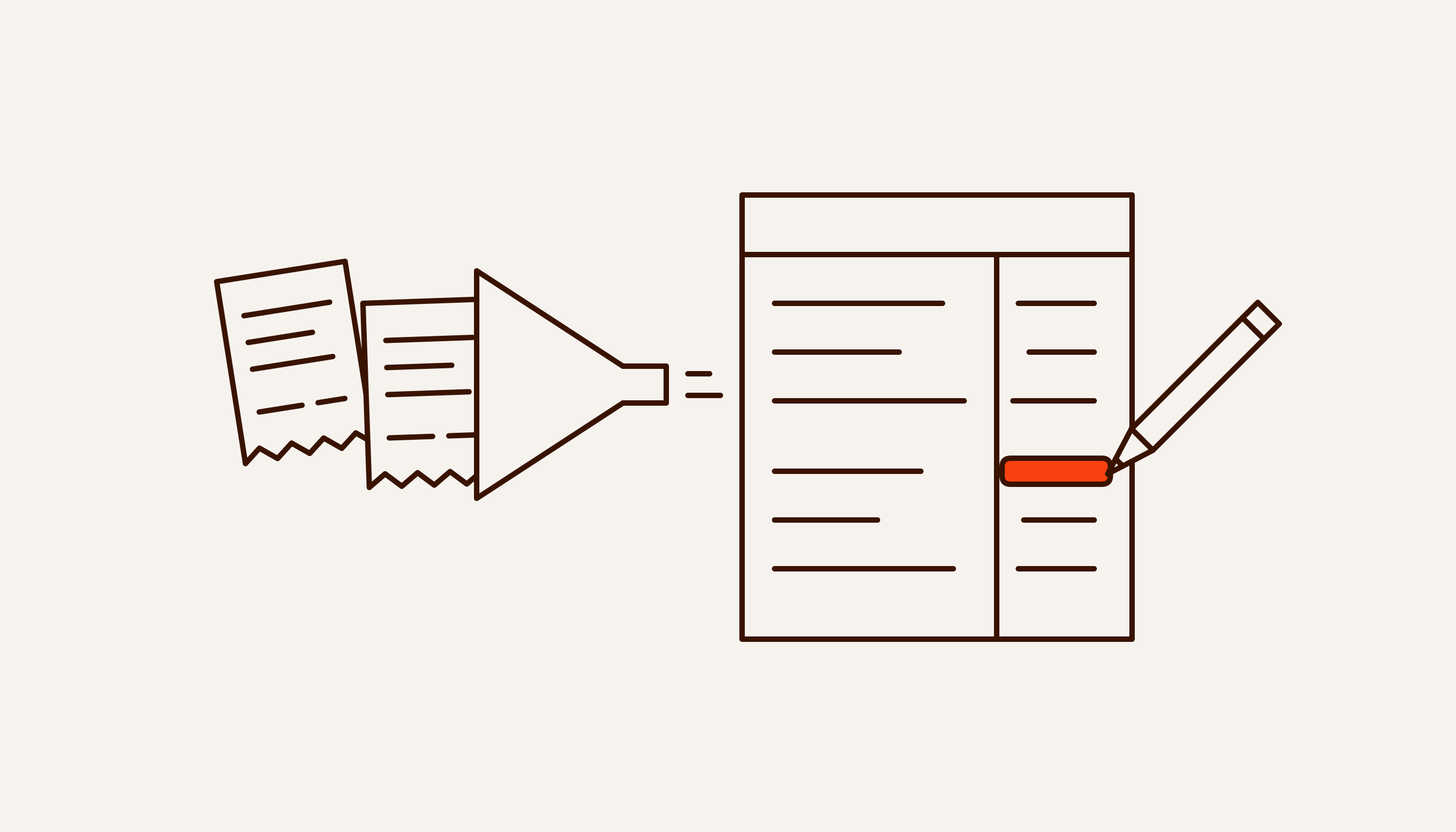
Today, AI in accounting is best at data entry: coding bank transactions and matching receipts and invoices to them. That is the picture from a study by Jung Ho Choi of Stanford and Chloe Xie of MIT, one of the first to measure the effect on accountants’ real work rather than only asking for opinions. In it, AI worked alongside accountants, not instead of them. Accountants who used AI more spent less time on data entry and more on clients and review, and the books closed faster.
Below: what exactly was measured, which figures survived into the journal version, which ones still circulate from the draft, what carries over to Uzbekistan, and where AI should not be making the call.
Who studied what
The paper, “Human + AI in Accounting: Early Evidence from the Field”, appeared in the Journal of Accounting Research, volume 64, issue 3, and is open access. It was received on 1 December 2024, accepted on 4 February 2026 and published online on 16 April. The authors registered the study in the American Economic Association’s trial registry on 31 October 2024, before the first survey wave.
It draws on three kinds of data.
- A survey. 277 accountants in two waves, November 2024 and March 2025. 268 were recruited through the Prolific and Connect online panels; the other 9 were staff accountants at the partner company. For several weeks in a row they logged how many clients they worked for and how they split their time across tasks.
- Platform data. The partner company, which the authors do not name, builds generative AI into standard accounting software such as QuickBooks. The sample holds about 200,000 transactions from 79 private US firms between January 2023 and March 2025. The median firm has 10 employees, and 42% of the firms are in information technology. An accountant reviews every AI suggestion.
- An experiment. 99 accountants coded the same 43 transactions against a chart of accounts with 153 categories. 52 worked with AI suggestions and 47 by hand; the groups were assigned at random.
The main caveat comes first. Firms and accountants chose for themselves whether to adopt AI, so the survey and the platform data show associations, not causes. The authors say so plainly: most results should be read as descriptive associations rather than causal effects. Only the experiment shows cause, and it covers a single task.
Where the accountant’s time goes
By November 2024, 38% of respondents had at least partly built generative AI into their work. They used it mostly for data entry (44%), administrative work (44%) and business communication (43%). Fewer used it for quality assurance (27%) or advisory work (15%).
The more an accountant used AI, the less time went on data entry. Comparing the extremes, people who never use it against people who use it many times a day, the share of time spent on data entry is 8.7 percentage points lower. In a 40-hour week that is about 3.5 hours. The authors themselves call this an extreme comparison and suggest a smaller step, one standard deviation: 2.6 points, or roughly an hour a week. The freed time went into client communication and quality assurance.
Heavier AI users also served more clients a week: 19% more per standard deviation. At the median of five clients, that is roughly one extra client. Comparing the extremes, they logged about 25% more billable hours, yet their total client count did not grow. As the authors read it, the time went into serving the same clients more deeply rather than taking on new ones. All of these figures are self-reported in the survey.
The platform data point the same way. For staff accountants, the share of page views spent in the auto-categorisation module fell by 2.6–2.8 points a month. At the start of the period, routine bookkeeping took about 31% of their time.
Choi described the mechanics in a Stanford GSB Insights article: every client needs a lot of prework, such as pulling information, connecting bank transactions and tracking vendors, and “AI assists with that setup”.
The books got faster and more detailed
The concern accountants picked most often in the survey was AI errors: 62% chose it. So the authors checked separately whether reporting quality suffered. They used two measures.
The first is timeliness: how many days after month-end a transaction lands in the general ledger. Across the sample the average was 7.6 days. After a firm moved onto the AI platform, that lag shrank by about 7.5 days, meaning transactions were recorded almost as soon as the month ended, or within the month itself. The authors read this as a faster month-end close. Other models give the same estimate, 7.5 to 7.9 days.
The second is granularity: how many distinct accounts a firm uses in its general ledger in a month. After adoption there were 0.9 more, against an average of 7.4, or about 12%. The Stanford GSB write-up gives an example: instead of a single payroll line, separate lines for bonuses, benefits and meals.
That figure is weaker than it looks. In alternative designs the effect is smaller, 0.4–0.7 accounts, and not always statistically significant. The authors themselves note that the speed gains hold up more reliably than the gains in detail.
The effect was also uneven. Firms at later funding stages, after venture rounds, private equity or debt financing, gained roughly one account, and their lag fell by 12.1 days. For early-stage firms, funded by an accelerator, crowdfunding or a seed round, there was no effect on granularity, and the lag fell by 7.4 days. The authors conclude that the more complex a firm’s finances, the bigger the payoff. They also caution that later-stage firms are a smaller, non-random subset of clients and call the difference a descriptive pattern rather than a proven effect.
When the accountant overrides the AI
For every transaction it codes, the platform shows a confidence score from 0 to 1. Accountants paid attention to it: when confidence fell from 1.0 to 0.7, the chance that a person changed the category rose by about 10 points. Suggestions were not accepted blindly.
Experienced accountants stepped in more selectively, exactly where the model was unsure. Less experienced ones, the authors observe, responded less to the score: they either trusted uncertain suggestions too much or barely used the system. One caveat: in the platform data, experience varies across only nine staff accountants.
Experience also shaped what they handed to the machine. By the authors’ estimate, an accountant with two more years of experience, one standard deviation in the sample, used AI about 6% more for coding transactions and about 3% less for amortising prepaid expenses. Simple work went to the machine; complex work stayed with the person.
The experiment showed both the gain and the cost of error. With AI suggestions, accountants coded transactions 17.5 percentage points more accurately than without them. For scale, average accuracy across all 99 participants was 74.7%. Total time did not change significantly, but each correctly coded transaction took about 10 seconds less. The suggestions were not uniform, though: for some transactions different participants got different options, and the rarer options were less accurate on average. When the AI offered one of those, participants were noticeably more likely to pick it. On average AI raises accuracy, but if nobody checks it, its mistakes end up in the books too.
In the call centre we covered in our piece on “95% of AI pilots fail”, AI helped newcomers most. Accounting looks different: experience is what tells you when not to trust the model.
Where “55% more clients” and “8.5% of time” come from
If you read about this study before, you probably saw other numbers. The working paper dated 7 May 2025, whose abstract is posted on the Stanford GSB site, reports a 55% increase in weekly client support and about 8.5% of accountant time moved from data entry to higher-value tasks. The 8.5% also appears in the June 2025 Stanford GSB Insights article.
The journal version has neither the 55% rise nor the 8.5% of time. In their place: 19% more clients per standard deviation (80% comparing the extremes) and 2.6 fewer points of time on data entry (8.7 for the extremes). The main text of the journal version no longer has the theoretical model from the draft, and the experiment grew from a preliminary pilot into a full one with 99 participants. The 12% and the 7.5 days stayed.
Between the two versions the paper went through peer review, and some of the numbers changed. Cite the published version. If a text says “55%”, its author was most likely summarising the draft.
Will AI replace accountants?
On this evidence, no. The authors conclude in the abstract that in practice AI works best as a tool that “augments—rather than replaces—professional judgment”. Chloe Xie put it more briefly in the same Stanford GSB Insights article: the technology “is not here to replace the human being”. Choi, talking about auditors in the same piece, said AI can help them synthesise information and standards and quickly get the gist, but “that final judgment call — that’s still a human decision”.
The US Bureau of Labor Statistics projection agrees. According to the BLS Occupational Outlook as of September 2026, employment of accountants and auditors will grow 5% between 2025 and 2035, with about 115,300 openings a year. The same page says some routine tasks such as data entry may be automated, but BLS does not expect this to reduce overall demand. That is a US projection, not a measurement.
As for when AI will replace accountants, none of these sources gives a date. According to the study, what goes is not the profession but a part of the work: data entry. Review, client work and the final say on disputed items stay with people.
The answer is not complete without the limits:
- Association, not cause. Firms chose whether to adopt AI, and they may have been the ones that needed fast, detailed books to begin with.
- One platform. US small and mid-sized firms, most of them in information technology.
- The survey sample. The authors note that online-panel respondents are younger and less experienced than US accountants overall and probably more comfortable with technology.
- Gross effect. The cost of the platform itself is not netted out of the productivity figures.
- A short window. The authors call the long-term effects uncertain.
We traced the lineage of “AI won’t replace you, a person using AI will” in a separate piece.
What carries over to Uzbekistan
The platform in the study works on bank feeds, receipts and invoices. Accounting in Uzbekistan runs on similar raw material, and much of it is already digital. Under Article 47 of the Tax Code (in Russian), a tax invoice is, as a rule, issued in electronic form in the e-invoice information system. The e-document service Didox has an API (in Russian) that returns incoming and outgoing documents as JSON, with the counterparty’s taxpayer number, amounts, VAT and contract number. Access requires a partner token.
So for e-invoices, nobody needs to turn paper into a row of data any more. What remains is the step where AI saved time in the study: coding those rows to accounts. Review still stays with the accountant.
The numbers do not carry over. The 7.5 days come from private US firms on a single platform, and the 17.5 points from an experiment on one set of 43 transactions. We found no study measuring the effect of AI on accounting in Uzbekistan. If the books are kept in 1C, the model needs access to it, and that is a separate integration with its own timeline and price.
Where AI should not make the call
Decisions that change a person’s position. Since January 2026, Law ZRU-1115 has added Article 7¹ (in Russian) to the Law on Informatization: in legally significant decisions affecting a person’s rights and freedoms, one may not rely solely on the conclusions of AI systems. The rule does not list which decisions count. Our analysis is in the piece on ZRU-1115.
Tax advice to a client. Law ZRU-787 (in Russian) classes advice on calculating and paying taxes as a tax consulting service (Art. 9). A tax consultant is an individual holding a qualification certificate (Art. 16), and the tax consulting organisation is liable for damage to the client, including lost profit (Art. 31). How this law applies to the everyday work of an accounting firm is something we have not analysed; that is a question for a lawyer. The logic is clear, though: tax advice is a service a person answers for, and we would not hand it to a model.
Signatures. The e-signature belongs to whoever answers for the document. That is our position, not a legal rule.
How to use AI in accounting: what goes to whom
| Task | Who does it | Why |
|---|---|---|
| Coding bank transactions and receipts | AI, disputed items to a person | In the study accountants stepped in where the model was unsure |
| Details and amounts from a photo of a contract, certificate or receipt | AI, checked by a person | A reading error becomes an error in the books |
| Answering clients about status, deadlines and required documents | AI, on topics the chief accountant has approved | This is information, not a decision |
| Reminders about source documents and deadlines | AI | The chief accountant approves the reporting calendar |
| Accruals and prepaid expenses | A person, with an AI draft | Experienced accountants in the study handed these to AI less often |
| Tax payable, tax advice | A person only | Tax advice is a regulated service under ZRU-787 |
| E-signatures, filing reports | A person only | A signature means responsibility |
| Decisions that change a client’s position | A person only | Article 7¹ of the Law on Informatization |
How to start:
- Measure the baseline with the study’s yardstick. How many days after month-end a client’s transactions reach the books, over the last two or three months.
- Pick one step and one or two clients. Coding bank transactions, for example, or answering clients about status.
- Ask the system for a confidence score on every transaction. Agree on a threshold: anything below it goes to a person.
- Count the overrides. The share of AI suggestions an accountant accepted without changes is the model’s accuracy on your data.
- Watch newcomers separately. In the study, less experienced accountants were the ones more likely to trust uncertain suggestions.
What we don’t know
We have not opened the paper’s online appendix with its additional tables. The authors do not name the partner company. They say they cannot independently verify how all of the platform’s raw records were generated, and that they cross-checked them against the survey and the experiment. We did not open the working paper on SSRN and compared the versions using the abstract on the Stanford GSB site.
We found no measurements of AI’s effect on accounting in Uzbekistan. Our reading of ZRU-1115 and ZRU-787 is ours, not legal advice.
Where we stand, honestly
No accounting firms are among our clients yet, so there are no figures of our own in this piece. We do not do AI transaction coding like the platform in the study. We do not touch the books in 1C either: entries, tax returns, e-signatures and online banking stay with the accountants.
What we offer accounting firms is a different part of the workflow, the conversation with clients: a Telegram bot that answers the firm’s clients at once, gathers a complete request, passes it to the assigned accountant and reminds clients about documents and deadlines. The bot gives no tax advice: tax figures come only from an accountant. We do not yet have an accounting version running: we would build the system for a firm within a project, from two of our own products. CorpVisor provides tasks, deadlines, reminders and a morning summary; today it runs orders, payments and team tasks at a manufacturing company in Samarkand. Valli answers clients in Telegram and is still in pilot. A connection to 1C or Didox is worked out for your system during the audit and estimated separately.
How the bot works and what stays with the accountants is on the accounting firm automation page. How we run a pilot on one process with a baseline metric is on AI implementation for business.
If you want to know which part of your accounting work to hand to AI first, describe the process in the questionnaire on our home page. The breakdown of one process arrives within 48 hours, free and without a call.