A market where the lead stays with the showroom
In 2025 local manufacturers sold 427,097 cars in Uzbekistan, 83.2% of them by UzAuto Motors (Spot, January 2026). In January–July 2026 the share of Chinese brands rose to 17.8%, up from 11.6% a year earlier (Xinhua, citing the ABA association). In May the JAC Motors Toshkent plant opened in Tashkent (Gazeta.uz).
One detail matters for this article. Chevrolet in Uzbekistan is sold through UzAutoSavdo: the contract and payment are done online, and the buyer comes to the dealer to collect the car (Spot, June 2025). There, the manufacturer runs the path from enquiry to contract. For dealers of Kia, BYD, Chery, Haval, JAC and other brands that path goes through the showroom, and the speed of handling a lead is the showroom’s job.
Why dealers don’t switch CRMs
An official dealer usually does not choose its customer system: the manufacturer sets it. Leads from the brand’s website, funnel reports and sales plans all run through it. It is how the manufacturer sees the way a dealer handles its customers, and how it rates the dealer.
Russia shows what this looks like next door. The dealer networks of Haval, Exeed, Tank, FAW, Hongqi, Changan and Voyah were being moved onto a single DNM platform by INFOTECH (according to the developer, November 2023). For dealers of Chery, Omoda, Jaecoo, Exeed and Tenet there is a commercial connector that links their 1C:Alfa-Auto to the LSAvtoPRO Dealer system and passes leads, sales, work orders and test-drive requests into it (Infostart, August 2026). A dealer may keep its own accounting system, but its leads still go into the system the brand sees.
So the advice “switch to a better CRM” is useless to a dealer. Even if the OEM system is awkward, it cannot be replaced. Running a second one in parallel means entering every customer twice and disagreeing with the manufacturer’s numbers.
A used-car lot or a showroom that is not a brand dealer is a different case. It has no OEM system, and a CRM for a car dealership is chosen the way it is for any sales team: amoCRM or Bitrix24, set up around its own process. How that kind of CRM implementation goes is described separately.
The right question is a different one: what happens to a lead before it reaches the OEM system, and after a manager has opened its card there.
Where leads get lost
Customers do not write where the CRM expects them. A form on the brand’s website usually lands in the manufacturer’s system on its own. A message to the showroom’s Instagram, a question in Telegram, a call to a manager’s mobile, a reply to a classified ad — do not. They live in employees’ phones, and the CRM gets whatever a manager had time to enter and did not forget.
That gives four typical places where sales leak. You can check each of them at your dealership within a week, before any automation.
- First response. How many minutes pass between a message and a reply during the day, in the evening and at weekends. What research actually says about this, we unpacked in a separate article.
- Lead never entered. Compare the number of enquiries across all channels in a week with the number of new customers in the CRM for the same week. The gap is customers that neither the head of sales nor the manufacturer knows about.
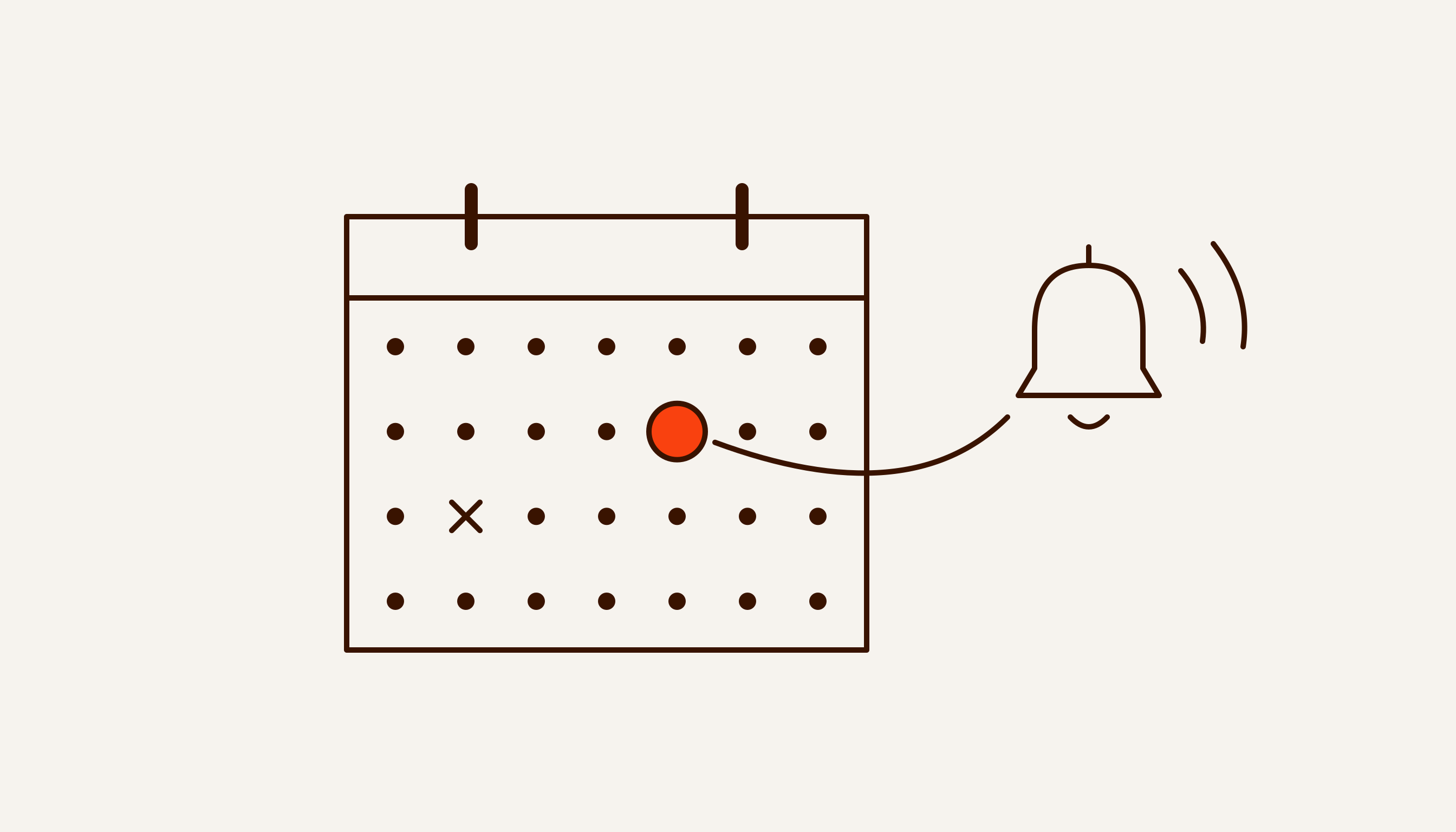
- Missed call-back. The customer said “I’ll think about it”, the manager promised to call on Thursday. Not everyone has a task for Thursday.
- Test-drive no-show. Booked, did not come. How many per week, and whether there was a reminder — that is the second article.
Nobody has published how large these losses are in Uzbekistan. Russia offers a reference point: the analytics service Callibri examined 581,449 enquiries to 255 auto businesses — showrooms, dealers, service shops, parts stores — from June 2024 to June 2025. Missed calls: 16%. Call-back requests left unanswered: 63%. Lost chats: about 21% (Callibri, 2025). This is a vendor’s data, not an independent audit, but the order of magnitude is telling.
All of this happens around the CRM, not inside it. That is also where it gets automated.
Four ways to connect AI to the OEM system
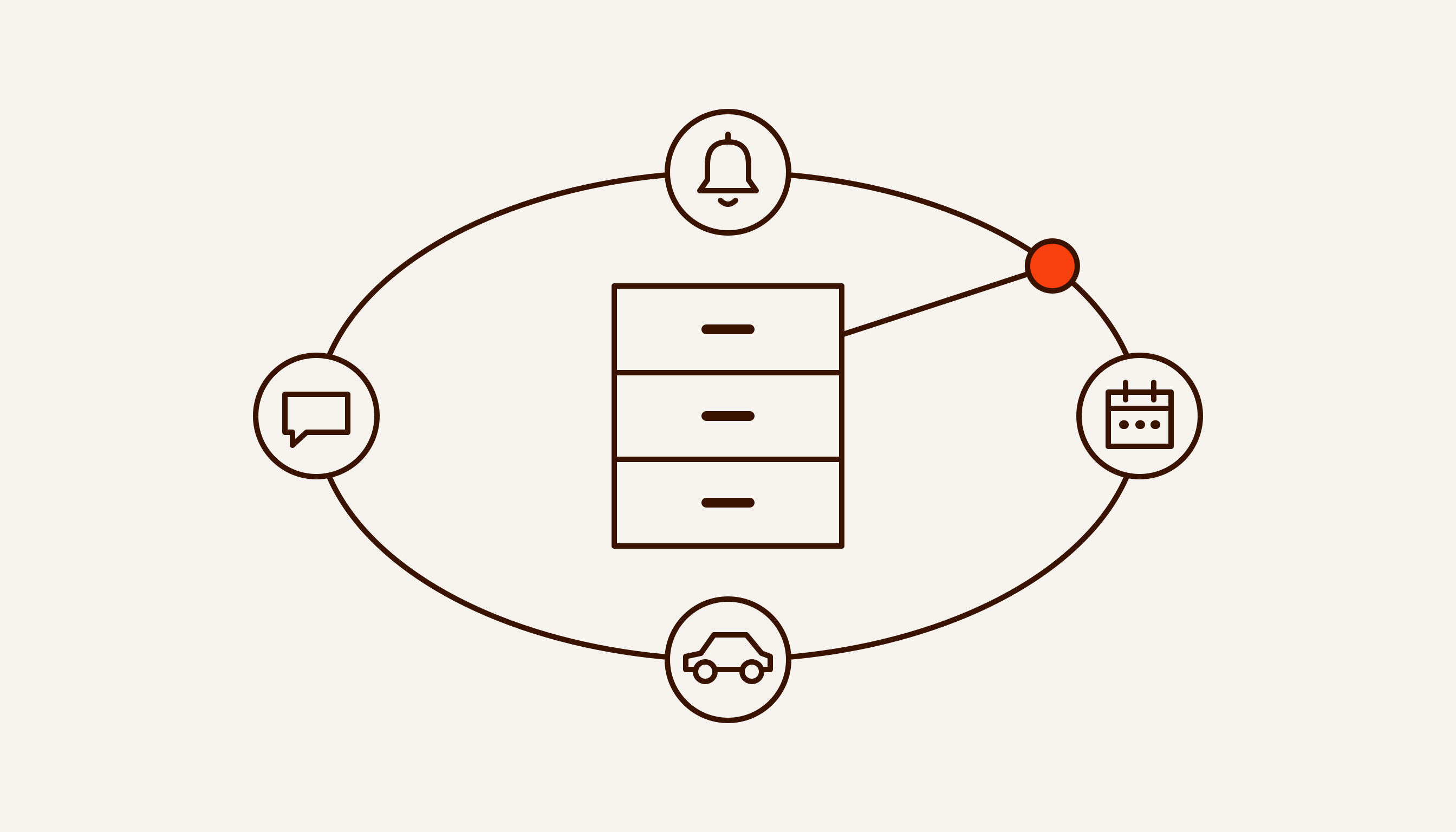
Whatever the method, the layer around the CRM does the same things: it answers the customer at once, asks questions from the dealership’s script, books the test drive, hands over to a manager and watches the deadlines. The methods differ in how data reaches the OEM system.
1. A card for the manager. The system prepares a filled-in card: name, phone, model, budget, loan or cash, trade-in, source. The manager copies it into the CRM in a minute. There is no integration, so this works with any system and launches within days. The downside is manual entry. But it can be checked: the layer knows which cards were issued and asks about every one that was not entered by the end of the day.
2. Reconciliation against an export. Most systems can export a list of customers or deals to Excel. Once a day the layer compares the export with its own conversations and shows the head of sales the gaps: there was a lead, the CRM does not have it. This needs no write access to the OEM system, only the right to export.
3. API or leads by email. If the manufacturer gives dealers programmatic access or accepts leads at a dedicated address, the layer enters them itself. This is full automation, but it depends on the manufacturer: access is not always granted, and not quickly. The person to ask is the brand representative, not the developer.
4. Robotic entry. A program logs into the CRM’s web interface under an employee’s account and fills in fields like a human. Technically this is almost always possible. We advise against it: the interface changes without warning, the robot breaks silently, and the OEM system’s terms of use may forbid it outright.
For a pilot the first method is almost always enough. The second is added when you need to prove that not a single lead was lost. The third comes once the pilot has paid off and there is something to take to the manufacturer.
The weak spot is the handoff to a human
In February 2026 Pied Piper published its annual measurement: mystery shoppers sent enquiries through the websites of 3,290 US dealerships. Not everyone got a personal reply: 14% of dealerships scored below 40 out of 100, meaning they did not personally respond. The authors also looked separately at cases where AI could not handle a question and escalated it to staff. Those evaluations scored nine points lower on average, and customers were twice as likely to receive no personal response (Business Wire, 23.02.2026). Pied Piper’s vice president Cameron O’Hagan put it this way: the greatest risk is in the handoffs, “between systems and from AI to dealership staff”.
That sets a requirement for each of the four methods. A bot that said “passing you to a manager” has not solved the task, only passed it on. The layer has to know whether the manager picked the lead up, nudge them after ten minutes of silence, and alert the head of sales after half an hour. Without that, automation speeds up the first reply and loses the customer on the second.
What lives where
A second customer database is not needed. The OEM CRM stays the main system for customers, deals and reports to the manufacturer. The layer next to it keeps what the CRM does not have: conversations, response times, reminders, test-drive bookings until they are entered.
If some data sits in both systems, decide in advance which one is right. Otherwise in a month the head of sales will have two different reports and will stop trusting both.
Personal data is a separate question. Since March 2026 conversations with customers in Uzbekistan can be sent to an external model abroad if one of three conditions is met. Call recordings are harder: the law does not say directly whether a voice recording counts as biometric data. Details are in our article on customer chats and ChatGPT.
What to measure in a pilot
Five metrics fit a dealership:
- median time to first response — separately for working hours, evenings and weekends;
- share of leads answered within 5 and 15 minutes;
- share of enquiries that reach the CRM the same day;
- test-drive show rate among those who booked;
- overdue call-backs at the end of the day.
In the first week you count all of this as it is, changing nothing. That is the “before” measurement. The success metric and the target number are written down before the pilot starts, in one sentence. That is how our pilots work: miss the number and the stage is not billed.
Two weeks are enough if there are at least a few dozen leads a week. With a smaller flow the difference between “before” and “after” drowns in noise, and the pilot should run longer.
How to choose the process for a pilot, we described in what to automate first. How not to fool yourself about the result — in our breakdown of “95% of AI pilots fail”.
What we don’t know
Which systems manufacturers require from dealers in Uzbekistan has not been described publicly: the examples in this article come from Russia. Requirements differ from brand to brand and from contract to contract. Only your brand representative can tell you what may be connected to your system.
The data on Russian dealers’ platforms comes from the developers of those systems. Callibri’s figures are a vendor’s data about its own clients. Pied Piper measures US dealers and only enquiries sent through websites. We found no studies of dealer response speed in Uzbekistan.
We do not yet have results from our own pilots at dealerships, so this article contains none of our own effect numbers.
The same scheme for other industries — reply, qualification, booking, a CRM card — is on Sales automation with AI.
What such a layer looks like at work is shown on the page for car dealerships, with a demo in Russian and Uzbek. To have one process at your dealership broken down, use the questionnaire on our home page or message us on Telegram.