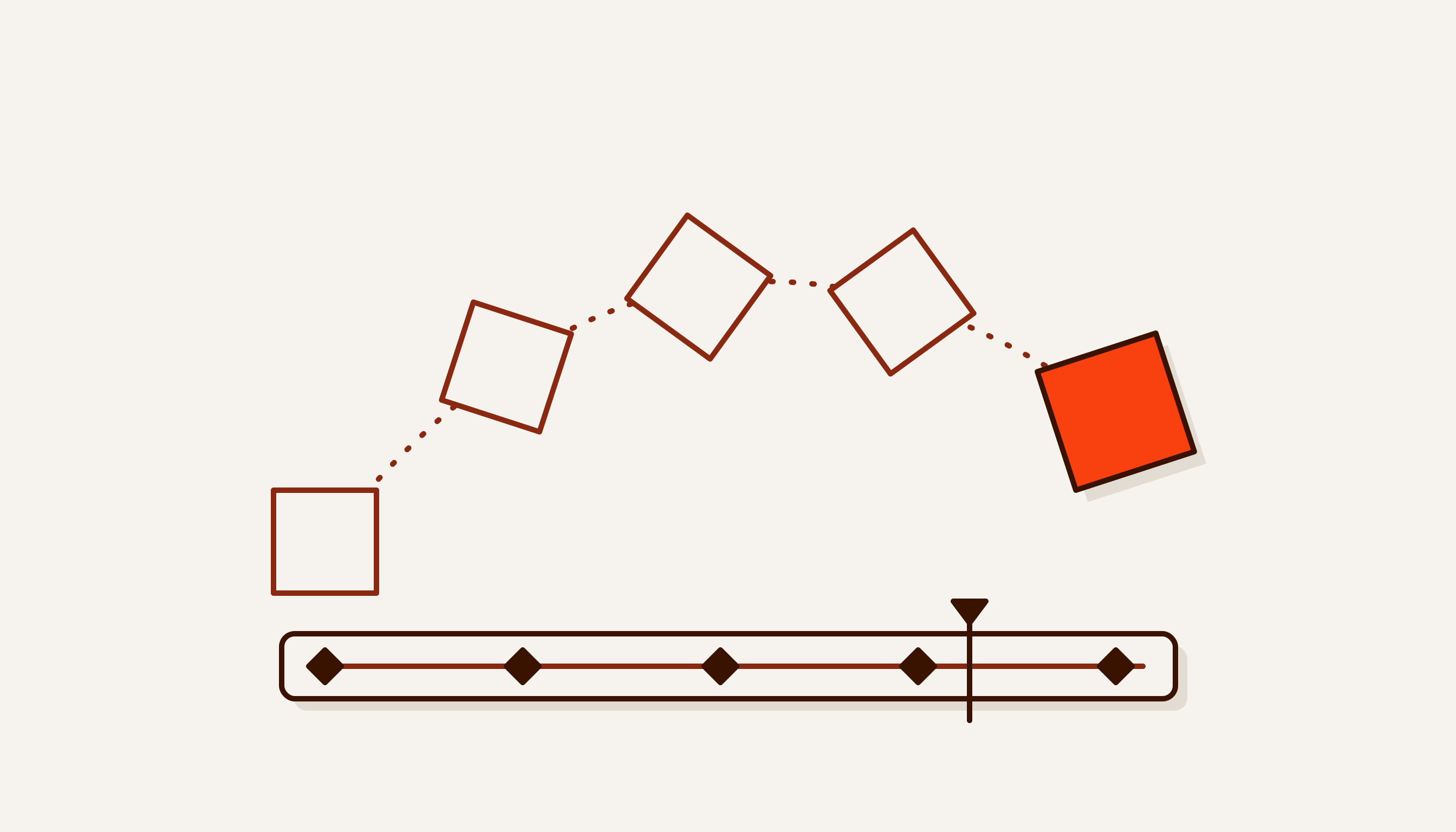
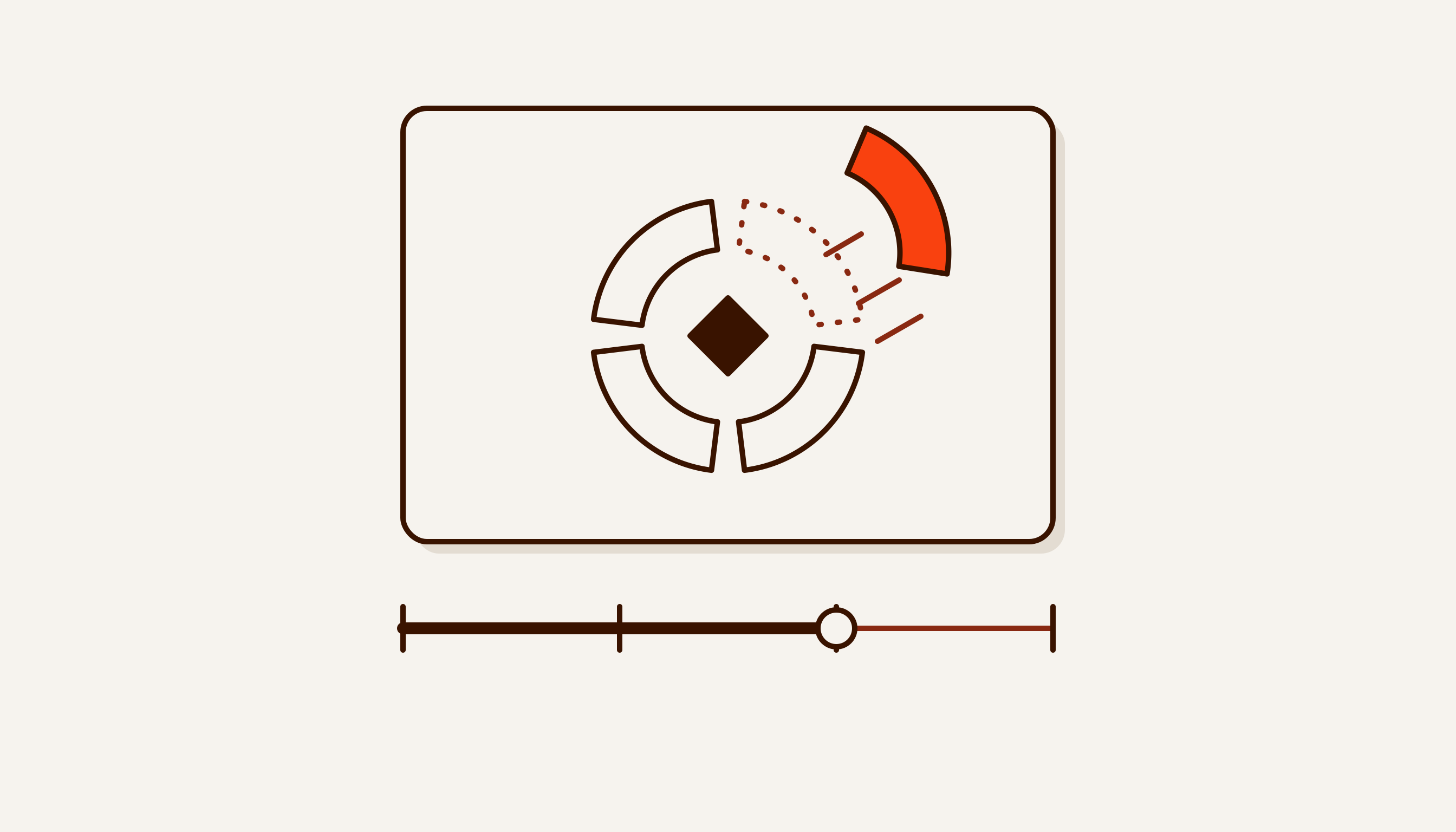
A logo animation is a short clip, usually 2–5 seconds long, in which a brand’s mark and name appear, assemble from parts or come to life. It goes at the start and end of videos and Reels, on a website’s loading screen, in presentations and on office screens. What you should order is not “an animation” but a set of files: MP4 for social media, MOV ProRes 4444 or WebM with a transparent background for editing and the website, Lottie for apps, a sticker for Telegram. Below: which file is for what, how many seconds are enough, and what free online generators and AI video tools put at risk.
Why a business needs a logo animation
- Video intros and outros. The same short animation at the start or end of every video teaches viewers to recognise the brand.
- Reels and Stories. In a vertical video the logo is better placed at the end: the first seconds should go to the point, not to an intro.
- Website. An animated mark on the loading screen or in the header. This calls for a light format, not a video weighing tens of megabytes. More in Animation on a website.
- Presentations and trade shows. An intro on the first slide, a loop on the stand’s screen.
- Office or showroom screen. The logo looping between product videos.
- Telegram. An animated sticker or video sticker with the logo for the channel and for chats with customers.
How long should a logo animation be?
There is no standard length, and we found no source for any “rule”. In our practice 2–5 seconds is enough for an intro: any longer and the viewer starts waiting for the actual video. Well-known sonic logos, which live alongside an animated mark, give a reference point. Intel’s sound, written in 1994 by composer Walter Werzowa, is a three-second, five-note signature (Intel). When Netflix commissioned its “ta-dum”, Todd Yellin, the company’s VP of Product, named brevity as the first requirement: “it had to be really short” (Twenty Thousand Hertz podcast, 2020).
Telegram sets hard limits: a video sticker may not exceed 3 seconds, and an animated sticker may not exceed 3 seconds either and must loop (Telegram).
So we make the main intro 3–5 seconds long, plus a separate version for social media. A sticker built to Telegram’s requirements is not part of the base price; we discuss it separately.
Output formats: which file is for what
| Format | Transparent background | Used for |
|---|---|---|
| MP4 (H.264) | No: H.264 has no built-in alpha support (Unity) | Social media, messengers, presentations. Meta asks for MP4 or MOV with H.264 compression for Reels ads (Meta) |
| MOV ProRes 4444 | Yes | Editing: placing the logo over any footage. The alpha channel is stored losslessly, up to 16 bits (Apple) |
| WebM (VP9) | Yes, in Chrome and Firefox | Website. Safari does not yet show transparency in VP9 (MDN), so it needs a second file, HEVC with alpha (Jake Archibald) |
| Lottie (JSON) | Yes, it is vector | Website and apps: an After Effects animation is exported to JSON and plays on Android, iOS, the web and Windows (Airbnb) |
| GIF | Only “pixel on or off” | Email, older platforms. The palette holds at most 256 colours, and only one palette colour can be transparent, with no partial transparency (GIF89a specification) |
| Telegram sticker | Yes, Telegram itself recommends a transparent background | Video sticker: WebM VP9, up to 3 seconds, up to 256 KB, one side 512 pixels, no audio. Animated sticker: Lottie-based TGS format, up to 64 KB, 60 frames per second (Telegram) |
Two caveats. ProRes 4444 is a format for editing, not for publishing: Apple’s table puts Full HD at 30 frames per second without alpha at about 330 Mbps, or 148 GB per hour (Apple). A five-second intro therefore weighs a couple of hundred megabytes. Support for transparent VP9 in Safari’s engine has been proposed, but as of 1 October 2026 the change has not been merged (WebKit on GitHub). So for now a website needs two files.
Sonic logo
A sonic logo is a short melody or sound that always plays with the mark. Intel’s is five notes (Intel). At the heart of Netflix’s “ta-dum” are sound designer Lon Bender’s wedding ring knocking on the side of a cabinet in his bedroom and a reversed, processed electric guitar recording (Twenty Thousand Hertz). Sound is optional, and on social media a video may be watched muted, so the animation has to work in silence. But if you plan radio, podcast or voice-message advertising, it is worth ordering a sonic logo together with the animation so that the two share a rhythm.
Free online tools, AI generators or After Effects?
Online generators and templates. You upload a logo and the service drops it into a ready-made animation. It is fast, but everyone who picked that template has the same animation. For scale: Videohive’s logo stings category holds 19,584 After Effects templates (Videohive), and the best seller among them had been bought more than 6,000 times as of 1 October 2026 (template page). Check the licence too. Canva’s content licence, for example, is non-exclusive, forbids claiming exclusive rights to library content and separately forbids using it as part of a trademark, with fonts excepted (Canva). A mark built from such elements will be hard to defend as your own. Before spending an evening on a free plan, check whether it adds a watermark, what resolution it exports and whether commercial use is allowed.
AI video generators. A video model “animates” a picture of the logo but does not know that the letters and proportions of a mark must not change. The developers say as much: in its description of the Gen-4.5 model, Runway warns that objects may disappear or appear unexpectedly across frames (Runway). For a logo, that means an extra or missing detail, or a letter that drifts. The second problem is rights. In January 2025 the U.S. Copyright Office concluded that prompts alone are not enough to protect the result: protection covers only what a human author has determined as expressive elements (U.S. Copyright Office). That is the US position; we found no guidance on this specific question in Uzbekistan.
After Effects. Adobe itself lists animating a logo among the program’s uses (Adobe). A vector logo from Illustrator is imported layer by layer and each part is animated separately. If you are ready to spend a few weeks learning, it is a good path. If you need one intro, ordering it is cheaper.
We animate logos in code or in Blender. In code the mark is animated straight from the vector file, so outlines and proportions stay exact in every frame. Blender comes in when the mark needs to become three-dimensional: material, lighting, a camera fly-around. We do not use generative video in our work.
What to prepare before ordering a logo animation
- The logo in vector form: SVG, AI, EPS or PDF, ideally with separate layers. A PNG from the website is only good for a draft.
- A brand book, or at least colours and fonts: colour codes, font files, clear space, forbidden versions of the mark.
- Where the animation will be shown: Reels, website, presentation, office screen, Telegram. This decides the list of files.
- Two or three examples you like, and one you definitely don’t.
- Sound: whether you need a sonic logo, and whether there is music you already use.
- Deadline and first screening: if the intro is needed for a trade show, that outweighs everything else.
How much a logo animation costs
We make logo animations from 1.9 million so’m (≈ $161 at the Central Bank of Uzbekistan rate of 1 October 2026, 1 USD = 11,808.76 so’m): a main 3–5 second intro plus a version for social media. Payment is 50/50; we name the exact price and timeline after a free brief and fix them in the contract. Other prices are in the price list (PDF, Russian).
What to do next
Find the vector file of your logo and write down where you will show the animation. That is two-thirds of the brief. How motion design differs from ordinary video and how work on a video is organised, we covered in Motion design: what it is. If you would like us to make your animation, get in touch on the Motion design page: we will reply with brief questions and suggest an idea for the motion.