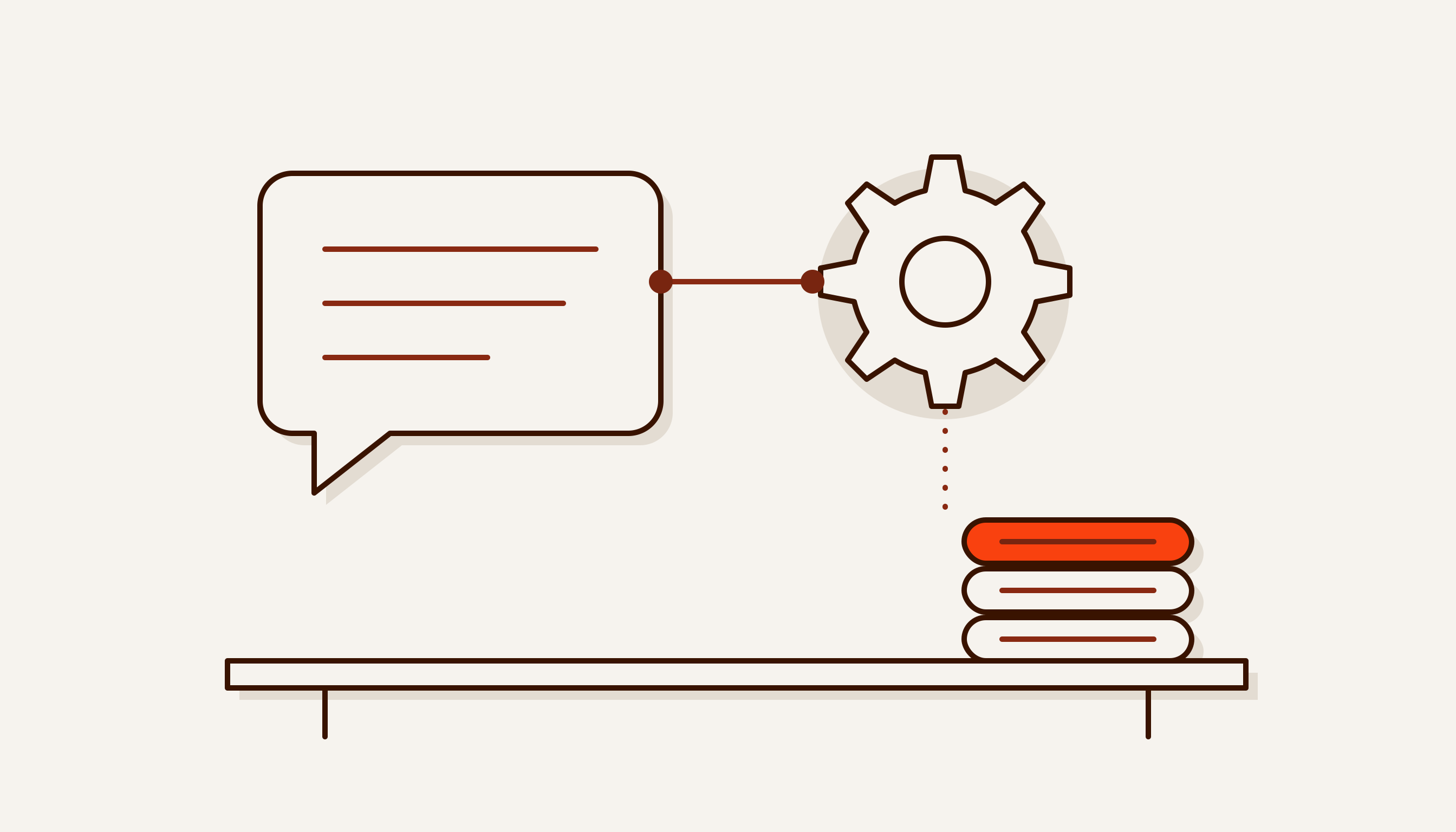
The WhatsApp Business API is Meta’s official channel for connecting a company number to software: a bot, a CRM, a shared inbox for several agents. You need it once a single phone running the WhatsApp Business app can no longer keep up. Meta itself charges no subscription; you pay for the messages your business sends. There are two ways in: connect yourself through the Cloud API, or go through a provider that charges a monthly fee but gives you a ready-made inbox.
The WhatsApp Business app or the API
The app runs on a phone and suits one person, a few at most. The API is a channel for software: a bot, a CRM, a service with a shared inbox for agents. The API has no chat window of its own.
| WhatsApp Business app | WhatsApp Business API | |
|---|---|---|
| Who replies | You, from the phone | A bot, a CRM or agents in the provider’s inbox |
| Per-message fees | None | Yes, for every delivered business message beyond the free allowances |
| Auto-replies | Greeting, away message, quick replies | Any flow, including an AI bot |
| CRM and 1C integration | No | Yes, via webhooks and the API |
| Broadcasts | “Business Broadcasts” — only for eligible accounts in select countries | With approved templates; the limit starts at 250 contacts a day |
| Who sets it up | You: install the app and confirm the number | A developer via the Cloud API, or a provider |
Sources: app features, API pricing.
If one person handles all chats from one phone, the app is usually enough. It already has a catalogue, labels and an away message. The API makes sense when two or more staff share the chats, when leads get lost between phones, or when customers expect an answer at night. If you send fewer than a thousand replies a month, Meta charges nothing for them and you pay only for the bot or the provider.
A word on “WhatsApp APIs” sold for a few dollars a month. These services link your number through a QR code as one more “linked device”. That is not the official API. WhatsApp’s Terms prohibit “bulk messaging, auto-messaging, auto-dialing” and creating accounts “through unauthorized or automated means”. One such service warns on its own site that WhatsApp’s anti-spam systems may restrict the account. Do not put the number your sales depend on behind a gateway like this.
What messages to +998 numbers cost
Since 1 July 2025 Meta charges for every delivered message from a business. Messages from customers are free. The price depends on two things: the message category and the country code of the recipient’s number. Where your company is registered barely matters; the exception is authentication messages to a few countries such as India. Uzbekistan has no separate line in the rate card: under Meta’s rules it belongs to “Rest of Asia Pacific”.
| Category | Used for | USD | So’m |
|---|---|---|---|
| Service | Replying within 24 hours of the customer’s message | 0.0113 | ≈135, first 1,000 a month free |
| Utility | Order status, appointment reminder, invoice — via template | 0.0113 | ≈135 |
| Authentication | Verification code | 0.0113 | ≈135 |
| Marketing | Promotion, new product, invitation — via template | 0.0842 | ≈1,005 |
Rates come from Meta’s rate card effective 1 October 2026. So’m amounts here and below use the Central Bank rate for 3 November 2026: 11,941.65 so’m per dollar. What changed on 1 October:
- Replies to customers are paid again. Each business number gets 1,000 free service messages a month, with no rollover. Charges start with the 1,001st.
- Utility messages inside the 24-hour window are now paid too. Before, an order-status update in an open window cost nothing.
There is one free window. If a customer writes to you from a Click to WhatsApp ad and you reply within a day, a window of up to 7 days opens. Messages in all four categories are free inside it.
Customers abroad cost a different amount:
| Customer’s number | Marketing, so’m | Utility or reply, so’m |
|---|---|---|
| Uzbekistan (+998) | ≈1,005 | ≈135 |
| Russia (+7) | ≈958 | ≈478 |
| Kazakhstan (+7, numbers starting with 6 or 7) | ≈721 | ≈215 |
| UAE (+971) | ≈688 | ≈187 |
| Turkey (+90) | ≈130 | ≈11 |
A reply to a customer in Russia costs three and a half times more than one to a customer in Tashkent. If a noticeable share of your chats is with customers in Russia, budget for it.
A monthly bill: an illustrative online shop
Take an online shop in Tashkent where every customer has a +998 number. Replace the figures with your own.
| What the shop sends | Volume | Paid | Meta, USD | So’m |
|---|---|---|---|---|
| Bot and agent replies within 24 hours | 2,500 | 1,500 | 16.95 | ≈202,000 |
| “Your order is with the courier” updates | 1,200 | 1,200 | 13.56 | ≈162,000 |
| One promotional broadcast to the base | 2,000 | 2,000 | 168.40 | ≈2,011,000 |
| Total | 198.91 | ≈2,375,000 |
Without the broadcast, Meta’s bill is about 364,000 so’m a month. Broadcasts, not conversations, drive the cost: a marketing message is 7.5 times the price of a reply. If you go through a provider, add its fee — about 656,000 so’m a month at 360dialog, for example. For comparison, Telegram’s bot platform is free; see How much does a chatbot cost in Uzbekistan.
How to connect: eight steps
The steps follow the Cloud API documentation. With a provider they are the same; it just does some of them in its own dashboard.
- A number. It must have a country code and be able to receive an SMS or a call. Short codes are not supported. A number currently used in regular WhatsApp or WhatsApp Business cannot be registered until that account is deleted (Meta). Delete it and you lose the chat history on the phone. There is a way around this; see coexistence below.
- A Meta business portfolio. Created in Meta Business Suite. A new portfolio can register only two numbers. After business verification or reaching the 2,000 limit, Meta raises the cap to 20.
- A developer app. On developers.facebook.com you create an app with the WhatsApp use case. The temporary token from the dashboard expires quickly. For production you need a system user with a permanent token.
- A display name. You provide it when registering the number, and Meta reviews it. Customers see it in your profile and in the chat.
- Payment method and currency. The currency is chosen when the account is created and is hard to change later: only through a separate migration process. The so’m is not on the list; the options include the dollar, the euro, the UAE dirham and 13 more currencies. Without a payment method, business replies stop as soon as the free thousand runs out. Add a card and test payment before launch, not on the day of your first broadcast.
- Templates. Anything you send first must be a template. Review takes up to 24 hours (Meta). Prepare three or four at once: order confirmation, appointment reminder, a follow-up after a pause.
- Webhook and bot. Incoming messages arrive at your endpoint — a bot, a CRM or a spreadsheet. What to put in a bot brief is covered in Chatbot requirements document.
- Business verification. You can start without it, but it raises your limits and template allowance. Unverified: 250 templates per account; verified with an approved display name: up to 6,000.
Limits for new accounts. The messaging limit counts how many different people you can message first, outside the 24-hour window, in a rolling day. A new portfolio starts at 250. The next tiers are 2,000, 10,000, 100,000 and unlimited (Meta). To reach 2,000, verify your business or deliver 2,000 messages using high-quality templates within 30 days. After that the limit rises one tier on its own if you used at least half of it over a week and quality stays high. The limit does not stop you from replying to people who wrote first.
Using the app and the API together (coexistence). If customers have known your number for years, you can connect it to the API without giving up the app. This is done through a Meta partner using Embedded Signup (Meta). The app must be version 2.24.17 or later. The API pulls in the last six months of chats; group chats are not synced. Some app features switch off: disappearing messages, view once, broadcast lists. Linked devices are unlinked. Supported ones can be linked again, but WhatsApp for Windows will not work.
Meta shut down the On-Premises API on 23 October 2025 (Meta). If a contractor offers to install WhatsApp on your own server, that option is obsolete.
Directly or through a provider
The Cloud API itself has no subscription fee. But it has no inbox for agents, and someone has to build the bot, the CRM link and chat storage. That is why most businesses use a provider. Two pricing models, from public price lists:
| Provider | Model | Price | In so’m, 3 Nov 2026 |
|---|---|---|---|
| 360dialog | Monthly fee per number, Meta rates on top | €49 a month (Regular), €99 (Premium) | ≈656,000 / ≈1,325,000 |
| Twilio | Fee per message, inbound and outbound, Meta rates on top | $0.005 per message | ≈60 per message |
Comparing provider fees only, the break-even point is about 11,000 messages a month: €49 ≈ 656,000 so’m divided by 60 so’m per message. Twilio counts inbound and outbound together. Below that volume the per-message fee is cheaper; above it, the flat fee. Before signing with any provider, ask:
- whether Meta bills you directly or the provider resells messages with a markup;
- which currency you pay in and how to pay from Uzbekistan;
- whose account it is: if the portfolio is in the provider’s name, the number may stay with them when you leave;
- whether you can export chat history and move the number to another provider;
- whether they support coexistence if you want to keep your history.
Rules that get numbers blocked
The essentials of the WhatsApp Business Messaging Policy, last updated 23 September 2026:
- Message only people who gave you their number. A purchased list or numbers taken from other chats do not qualify. Meta recommends separate opt-in for each category, such as order updates and promotions.
- Honour every opt-out request. Even if the person asked by phone rather than in WhatsApp. Broadcasts must make it clear how to opt out.
- A bot must hand over to a human. Automation inside the 24-hour window is allowed, but there must be a prompt, clear path to a live agent or a phone number.
- Alcohol, tobacco and medicines are off-limits. As a rule, WhatsApp cannot be used to sell or promote alcohol, tobacco, drugs (prescription included), medical products or real-money gambling. Meta makes exceptions only in certain countries and only on the API. A pharmacy or a medical supplies shop in Uzbekistan should not count on a WhatsApp sales bot, even if it technically works.
- A general-purpose AI chatbot is banned. Under the platform terms (section 4.7; the current version was updated on 23 September 2026), AI providers whose AI is the primary rather than an ancillary function are barred from the platform. An AI bot that answers questions about your products and bookings is ancillary. An “ask the AI anything” service is barred. WhatsApp data may not be used to train models, except to fine-tune a model used only by you.
- Templates get paused over complaints. If customers often block you or ignore a broadcast, Meta pauses the template.
Uzbek law applies as well. A customer’s phone number and chat history are personal data, and you need consent to process them regardless of Meta’s rules. What the law requires is covered in Uzbekistan’s personal data law.
Where we stand, honestly
We build chatbots for business in Telegram and WhatsApp. In WhatsApp we work through the WhatsApp Business API on a per-project basis; we have no WhatsApp bots in production yet, so there is no separate WhatsApp bot price on our site — we quote after a review. For reference: a Telegram chatbot starts at $300 with a two-week timeline, then a subscription of 700,000 so’m a month from the second month, for up to 1,000 customers. If the bot must pass leads to a CRM or 1C, that is our Pipeline package: from $1,200 plus $300 a month, up to three integrations. Clients in Uzbekistan can pay in so’m at the Central Bank rate on the invoice date.
You pay Meta or the provider directly for WhatsApp messages; we make nothing on them. In Uzbekistan customers are more often on Telegram, so sometimes the right answer is both channels on the same logic, and sometimes you do not need WhatsApp at all. We have no client case studies with numbers yet: the company has been operating since August 2026.
If you are not sure you need the API, start with a free review: two questions in the quiz on the home page, an answer within 48 hours, no call required to begin.