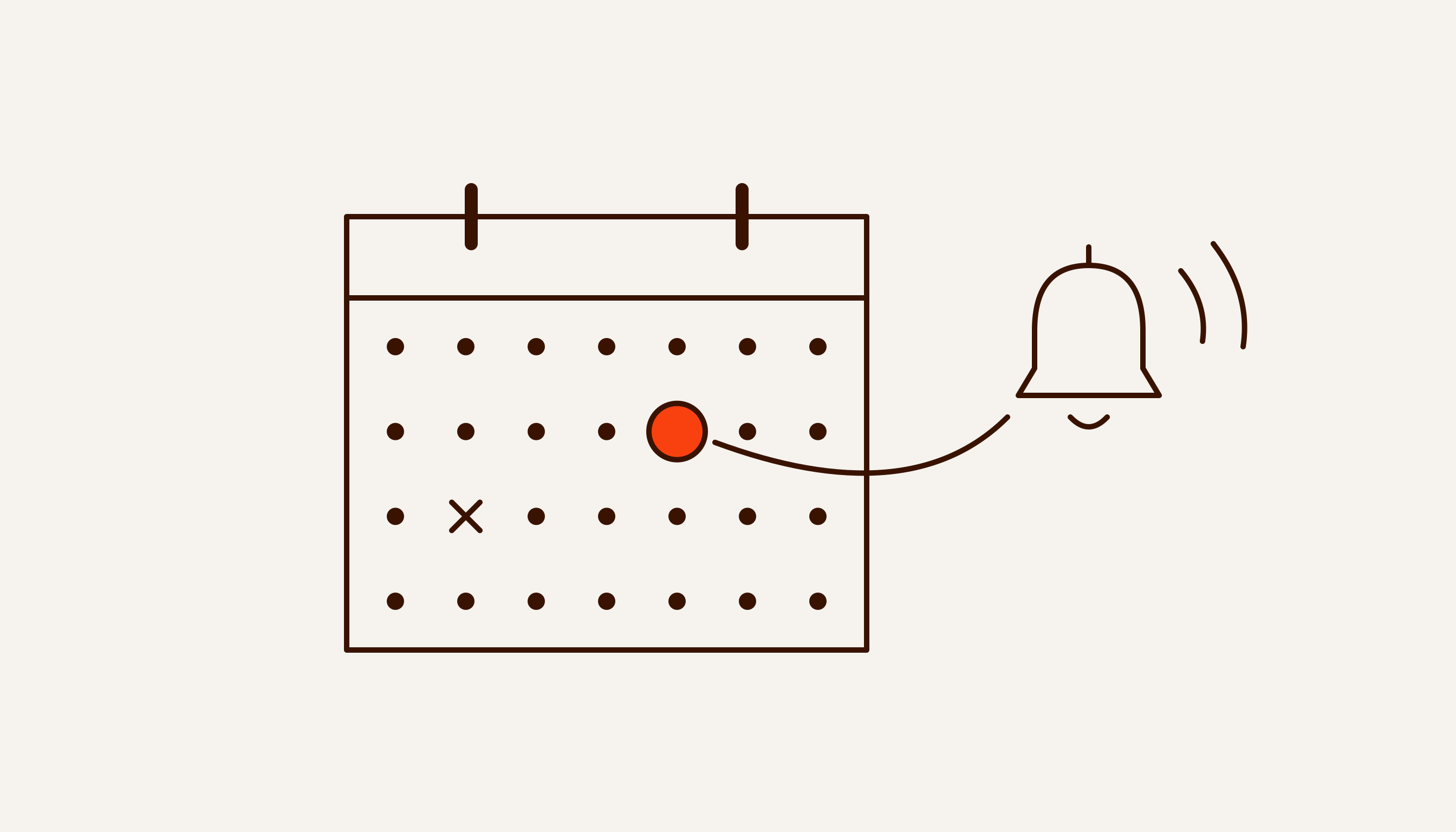
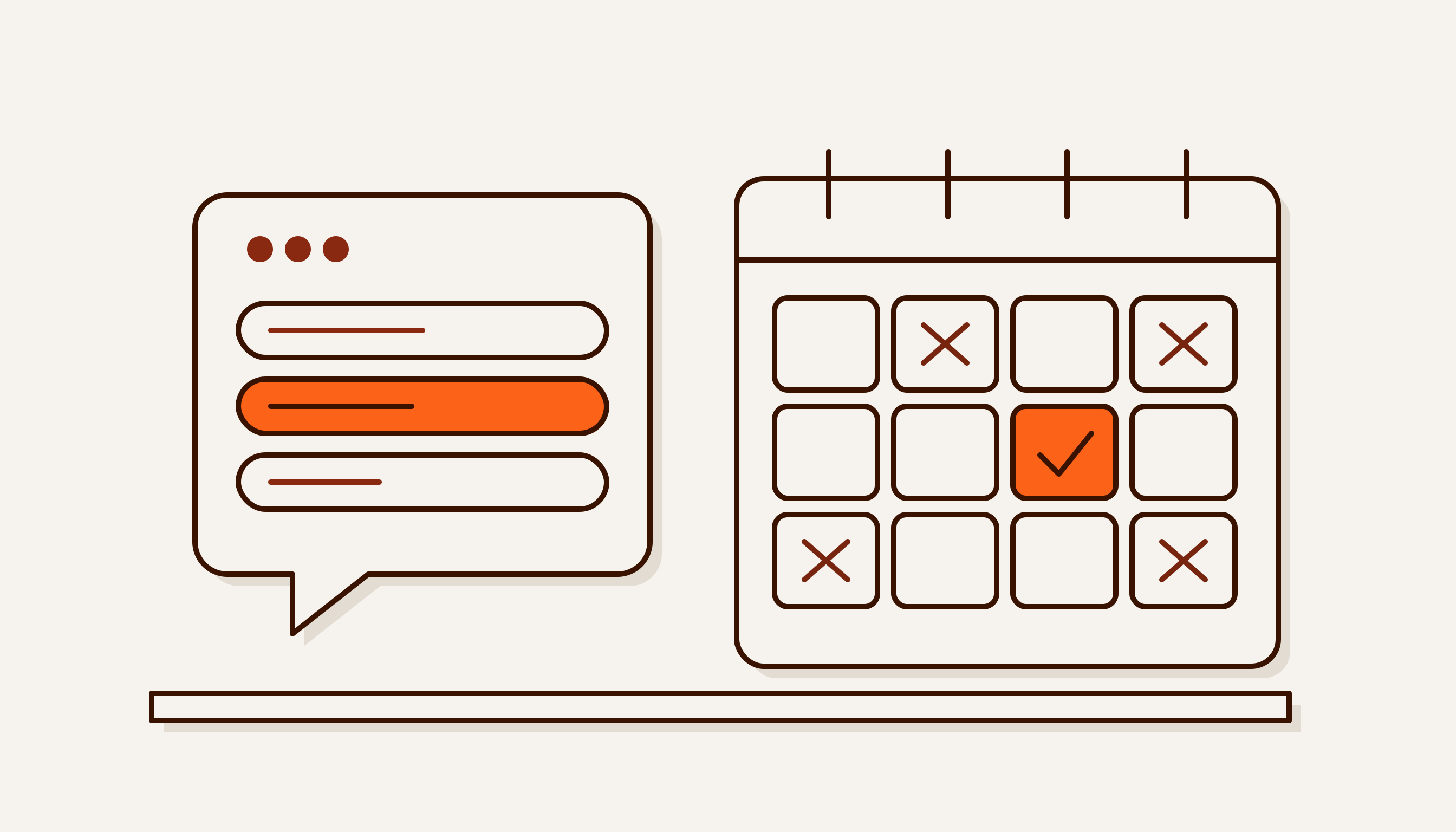
A Telegram booking bot works like this: the client picks a service, a specialist and a free time slot, shares their phone number with one tap and gets a confirmation. The day before the visit the bot reminds them and lets them cancel with one button. Staff see the booking in a calendar or a spreadsheet, not buried in a chat. You can build such a bot yourself in a bot builder from about 197,000 so’m a month. Tashkent studios charge from 4.7 million so’m, and from 9.6 million with a CRM link and automatic reminders. The main thing to decide before paying is where the schedule will live.
The booking flow: six steps
The client’s path through a booking bot is six steps. Each one is a separate decision worth writing into the brief.
- Entry. The client finds the bot via a t.me/bot_name link — from an Instagram profile, a website, a QR code at reception. The bot cannot message first: the client has to press “Start” (Telegram docs).
- Service. Buttons with the list of services, each with a duration and price. The bot needs the duration to calculate slots: a 40-minute haircut and a three-hour colouring take different space in the day.
- Specialist. Can be skipped if the client doesn’t care; the bot then finds the first free slot with anyone. In a clinic it’s a doctor or room, in a car service a bay.
- Date and time. The bot shows only free slots. The simple version is buttons with dates, then hours. A calendar grid in a Mini App — a web page that opens inside Telegram — is more convenient.
- Phone. A “Share phone number” button sends the number from the Telegram account; nothing to type. It only works in a private chat with the bot (Bot API, KeyboardButton). A consent line must come before the button — more on that below.
- Confirmation. To the client: address, time, and “Reschedule” and “Cancel” buttons. To staff: a new-booking notification.
Drop any step you can. A salon with one specialist doesn’t need step 3. In Uzbekistan, build buttons and texts in Russian and Uzbek from day one: the client picks the language once, on the first screen.
Where the schedule lives
The bot has to know when each specialist works, their breaks and days off, and how long each service takes. It also has to account for bookings staff took by phone. That requires one shared schedule the bot reads free time from.
It usually lives in one of three places:
| Where the schedule lives | Fits when | What can go wrong |
|---|---|---|
| Google Calendar or a spreadsheet | 1–5 specialists, staff already use a calendar | A phone booking went into the wrong calendar, and the bot sold a taken slot |
| A booking service or CRM | Many specialists, you need reports and a client base | Bot and service sync with a delay, and two clients grab the same slot |
| The bot’s own database | Bookings come only through the bot | Calls and walk-ins never reach the database, so the schedule drifts from reality |
One rule: the schedule is kept in one place, and everything else reads it. If the receptionist keeps writing bookings in a notebook, the bot will make mistakes whatever the technology.
Test three cases before launch. Two clients pick the same slot at the same moment — the second must see “slot already taken”, not a confirmation. A long service doesn’t fit before a break — the bot must not offer it. A specialist falls ill — there must be a one-button way to close their day and offer everyone booked a new time.
Reminders and cancellations
A meta-analysis of 21 studies found that SMS reminders cut the no-show rate from 21% to 15%, by about a quarter (BMJ Open, 2016). In a trial of 54,066 patients, one reminder a day before gave 5.3% missed visits, while two — three days before and a day before — gave 4.4% (Steiner et al., 2018). All of these studies were done in clinics. There is no comparable data for salons or car services, but the mechanism is the same: people forget.
What to carry over into the bot:
- Two reminders instead of one. The trial used three days and one day before. For a salon where people book a few days ahead, the evening before and the morning of the visit is a sensible choice. That is our suggestion, not a trial result.
- A “Cancel” button in the reminder itself. A cancellation a day ahead is not a loss: the slot can go to someone else. Penn Medicine ran a trial on 59,994 patients at high risk of missing appointments: an automated call with “confirm, cancel or reschedule” options was added to the usual SMS. No-shows fell from 11.3% to 9.6% (NEJM Catalyst, 2026).
- A waiting list. When someone cancels, the bot offers the freed slot to people who asked for that time.
A Telegram limit: the bot can only remind people who started it themselves. Someone who booked by phone and never opened the bot will not get a message — those bookings stay with staff. If a client blocked the bot, the message won’t arrive; Telegram tells the bot about the block (Bot API), and a good bot hands that booking to staff for a call.
More on what is actually known about reminders — in Reminders vs no-shows.
Prepayment via Click and Payme
The bot can send an invoice right in the chat. Telegram charges no commission for this and does not store payment details (Telegram Bot Payments). The payment provider takes its own fee, set by your contract with it.
At Botforge, Click, Payme and Rahmat payments come with the $400 “Business” package; at iCORP, Payme and Click are part of the Mini App from 24 million so’m.
Not everyone needs prepayment. For a 100,000 so’m haircut, an extra card step is more likely to put the client off. For a half-day service, where a no-show leaves the specialist idle, a prepayment or deposit makes sense. Decide before ordering: it determines which package you need and whether you’ll need a contract with a payment provider.
Builder or studio: prices as of 26.10.2026
Three routes, cheapest first:
| Route | Example and price | What you get |
|---|---|---|
| Bot builder with a template | Puzzlebot: free with ads up to 50 users; “Start” — 1,340 roubles a month with auto-payment, about 197,000 so’m, up to 1,000 users (puzzle.bot) | You assemble it from blocks and pay while you use it. Prices are in roubles |
| Studio, simple bot | Botforge, “Business” — $400, about 4.7 million so’m, 3–5 days: online booking, orders, Click, Payme and Rahmat payments (botforge.uz) | A bot built around your services. Support after the free period is about $10 an hour or a fixed monthly fee |
| Studio, bot with integrations | iCORP, “Advanced” — from 9,600,000 so’m, 4–6 weeks: booking with date and time selection, automatic reminders, amoCRM or Bitrix24, three months of support (icorp.uz) | Bookings go straight into the CRM, plus broadcasts and analytics |
Exchange rate used: Central Bank of Uzbekistan on 24.10.2026 — 11,838.92 so’m per dollar and 147.05 per rouble (cbu.uz).
A builder is enough if you have few specialists and a simple schedule. A studio makes sense if bookings must reach your CRM or 1C, take payment or cover several branches. Before ordering, ask where the schedule will be stored, who owns the bot and its token, and what support costs after the free period. The full first-year budget is in How much a chatbot costs in Uzbekistan.
Building it yourself
The builder route takes five steps:
- Open @BotFather in Telegram, send /newbot, set the bot’s name and username. BotFather gives you a token — the string a service uses to control the bot (Telegram tutorial).
- Paste the token into the builder and pick a booking template if there is one.
- Add services with durations, specialists and working hours.
- Connect the calendar or spreadsheet staff already use. If the builder can’t, the schedule will live only inside it — see the table above.
- Book the same slot from two phones and check the reminder and cancellation.
Keep the token like a password: whoever has it controls the bot. You can revoke it in the same @BotFather.
Ready-made Python booking bots are free on GitHub. Besides code, though, they need a server running around the clock and a person to fix the bot when it goes down on a Saturday morning. Without that person, free code ends up costing more than a builder.
You can also take bookings straight from chats with the salon’s own account: the bot is connected to a personal account and replies on its behalf. How to do it — in Telegram auto-reply without Premium.
Client phone numbers and the law
A client’s name and phone number are personal data. Uzbekistan’s Law “On Personal Data” (ZRU-547, Article 21) allows consent in any form that lets you confirm it was obtained, and the client can withdraw it. For a bot this means one line before the “Share phone number” button, such as “By sending your number you agree we use it for bookings and reminders”, with a link to the privacy policy. And a command the client can use to ask for their data to be deleted.
Storing such data inside Uzbekistan is no longer mandatory. Since 27 March 2026, law ZRU-1125 requires in-country storage only for biometric and genetic data and data of users of telecom operators’ services. Other data may be stored abroad if one of the law’s conditions is met — for example, the country is on the list of states with adequate data protection approved by the Cabinet of Ministers. For a bot on a foreign builder this means client numbers sit abroad, which is lawful only if one of those conditions holds. Ask the service where the data is stored.
If the bot answers clients through an AI model, the conditions are covered in Customer chats in ChatGPT and Claude.
Pre-launch checklist
- A list of services with duration and price in Russian and Uzbek.
- One place where the schedule lives, and an agreement with staff that phone bookings go there too.
- Tests: two clients in one slot, a long service before a break, a specialist’s day closed.
- Two reminders, each with a cancel button.
- What the bot does with a non-standard question: hands it to staff with the chat history.
- A consent line before the phone button and a link to the privacy policy.
- A t.me link to the bot in your Instagram profile, on your website and a QR code at reception — otherwise nobody reaches the bot.
- Access to the bot and its token stays with you, not only with the contractor.
To describe all this to a contractor, use the template in Chatbot requirements document.
Where we stand, honestly
Booking is one of the jobs we cover with chatbots: slots, confirmations, reminders, and handing anything non-standard to a manager with the chat history. A Telegram chatbot costs from $300 with us, about 3.55 million so’m at the Central Bank rate, in 2 weeks. From the second month there is a subscription of 700,000 so’m a month, up to 1,000 clients. If bookings must reach a CRM or 1C, that is the “Pipeline” package, from $1,200. If you have one specialist and a simple schedule, a builder is the better deal.
We don’t have client case studies with numbers yet. We do have our own bot — Valli, which handles client chats in Telegram and is currently in pilot.
You can start with a free review: two questions in the quiz on the home page, an answer within 48 hours, no call needed.